


- Afhalen na 1 uur in een winkel met voorraad
- Gratis thuislevering in België vanaf € 30
- Ruim aanbod met 7 miljoen producten
- Afhalen na 1 uur in een winkel met voorraad
- Gratis thuislevering in België vanaf € 30
- Ruim aanbod met 7 miljoen producten





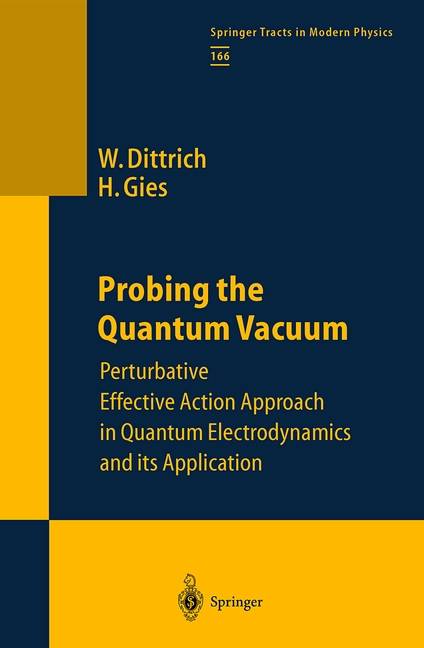
Probing the Quantum Vacuum
Perturbative Effective Action Approach in Quantum Electrodynamics and Its Application
Walter Dittrich, Holger Gies
€ 162,45
+ 324 punten
Uitvoering
Omschrijving
This book is devoted to an investigation of the vacuum of quantum elec trodynamics (QED), relying on the perturbative effective action approach. If the vacuum is probed with external perturbations, the response of the system can be analyzed after averaging over the high energy degrees of freedom. This results in an effective description of the properties of the vacuum, which are comparable to the properties of a classical medium. We concentrate primarily on the physics of slowly varying fields or soft photons by integrating out the high energy degrees of freedom, i.e. the elec trons, employing Schwinger's proper time method. We derive a new represen tation of the one loop photon polarization tensor, coupling to all orders to an arbitrary constant electromagnetic field, fully maintaining the dependence on the complete set of invariants. On the basis of effective Lagrangians, we derive the light cone condition for low frequency photons propagating in strong fields. Our formalism can be extended to various external perturbations, such as temperature and Casimir situations. We give a proof of the "unified formula" for low energy phenom ena that describes the refractive indices of various perturbed quantum vacua. In the high energy domain, we observe similarities between a vacuum with a superstrong magnetic field and a magnetized plasma. The question of mea surability of the various effects is addressed; a violation of causality is not found.
Specificaties
Betrokkenen
- Auteur(s):
- Uitgeverij:
Inhoud
- Aantal bladzijden:
- 244
- Taal:
- Engels
- Reeks:
- Reeksnummer:
- nr. 166
Eigenschappen
- Productcode (EAN):
- 9783642086861
- Verschijningsdatum:
- 8/12/2010
- Uitvoering:
- Paperback
- Formaat:
- Trade paperback (VS)
- Afmetingen:
- 156 mm x 234 mm
- Gewicht:
- 362 g



Alleen bij Standaard Boekhandel
+ 324 punten op je klantenkaart van Standaard Boekhandel
AANGERADEN


Beoordelingen
We publiceren alleen reviews die voldoen aan de voorwaarden voor reviews. Bekijk onze voorwaarden voor reviews.