


- Afhalen na 1 uur in een winkel met voorraad
- Gratis thuislevering in België vanaf € 30
- Ruim aanbod met 7 miljoen producten
- Afhalen na 1 uur in een winkel met voorraad
- Gratis thuislevering in België vanaf € 30
- Ruim aanbod met 7 miljoen producten





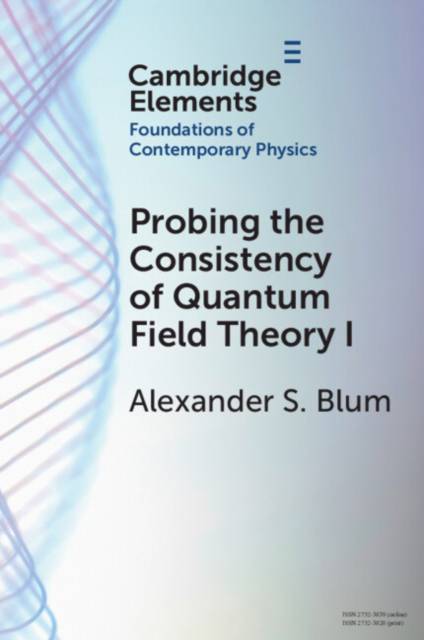
Probing the Consistency of Quantum Field Theory I
From Nonconvergence to Haag's Theorem (1949-1954)
Alexander S Blum
€ 36,45
+ 72 punten
Uitvoering
Omschrijving
This two‐volume Element reconstructs and analyzes the historical debates on whether renormalized quantum field theory is a mathematically consistent theory. This volume covers the years the years immediately following the development of renormalized quantum electrodynamics. It begins with the realization that perturbation theory cannot serve as the foundation for a proof of consistency, due to the non-convergence of the perturbation series. Various attempts at a nonperturbative formulation of quantum field theory are discussed, including the Schwinger-Dyson equations, GunnarKällén's nonperturbative renormalization, the renormalization group of MurrayGell-Mann and Francis Low, and, in the last section, early axiomatic quantum field theory. The second volume of this Element covers the establishment of Haag's theorem, which proved that even the Hilbert space of perturbation theory is an inadequate foundation for a consistent theory. This title is also available as Open Access on Cambridge Core.
Specificaties
Betrokkenen
- Auteur(s):
- Uitgeverij:
Inhoud
- Aantal bladzijden:
- 116
- Taal:
- Engels
- Reeks:
Eigenschappen
- Productcode (EAN):
- 9781009265331
- Verschijningsdatum:
- 26/02/2026
- Uitvoering:
- Paperback
- Formaat:
- Trade paperback (VS)
- Afmetingen:
- 152 mm x 229 mm
- Gewicht:
- 163 g


Alleen bij Standaard Boekhandel
+ 72 punten op je klantenkaart van Standaard Boekhandel
Cadeau

AANGERADEN


Beoordelingen
We publiceren alleen reviews die voldoen aan de voorwaarden voor reviews. Bekijk onze voorwaarden voor reviews.