


- Afhalen na 1 uur in een winkel met voorraad
- Gratis thuislevering in België vanaf € 30
- Ruim aanbod met 7 miljoen producten
- Afhalen na 1 uur in een winkel met voorraad
- Gratis thuislevering in België vanaf € 30
- Ruim aanbod met 7 miljoen producten





€ 147,45
+ 294 punten
Omschrijving
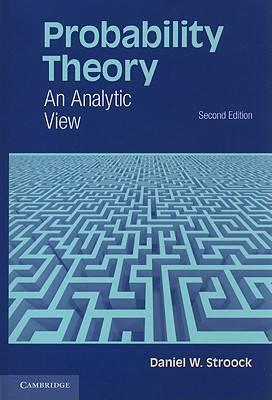
This second edition of Daniel W. Stroock's text is suitable for first-year graduate students with a good grasp of introductory, undergraduate probability theory and a sound grounding in analysis. It is intended to provide readers with an introduction to probability theory and the analytic ideas and tools on which the modern theory relies. It includes more than 750 exercises. Much of the content has undergone significant revision. In particular, the treatment of Levy processes has been rewritten, and a detailed account of Gaussian measures on a Banach space is given. The first part of the book deals with independent random variables, Central Limit phenomena, and the construction of Levy processes, including Brownian motion. Conditioning is developed and applied to discrete parameter martingales in Chapter 5, Chapter 6 contains the ergodic theorem and Burkholder's inequality, and continuous parameter martingales are discussed in Chapter 7. Chapter 8 is devoted to Gaussian measures on a Banach space, where they are treated from the abstract Wiener space perspective. The abstract theory of weak convergence is developed in Chapter 9, which ends with a proof of Donsker's Invariance Principle. The concluding two chapters contain applications of Brownian motion to the analysis of partial differential equations and potential theory.
Specificaties
Betrokkenen
- Auteur(s):
- Uitgeverij:
Inhoud
- Aantal bladzijden:
- 550
- Taal:
- Engels
Eigenschappen
- Productcode (EAN):
- 9780521761581
- Verschijningsdatum:
- 31/12/2010
- Uitvoering:
- Hardcover
- Formaat:
- Ongenaaid / garenloos gebonden
- Afmetingen:
- 178 mm x 254 mm
- Gewicht:
- 1088 g


Alleen bij Standaard Boekhandel
+ 294 punten op je klantenkaart van Standaard Boekhandel
Cadeau

AANGERADEN


Beoordelingen
We publiceren alleen reviews die voldoen aan de voorwaarden voor reviews. Bekijk onze voorwaarden voor reviews.