


- Afhalen na 1 uur in een winkel met voorraad
- Gratis thuislevering in België vanaf € 30
- Ruim aanbod met 7 miljoen producten
- Afhalen na 1 uur in een winkel met voorraad
- Gratis thuislevering in België vanaf € 30
- Ruim aanbod met 7 miljoen producten





€ 53,45
+ 106 punten
Omschrijving
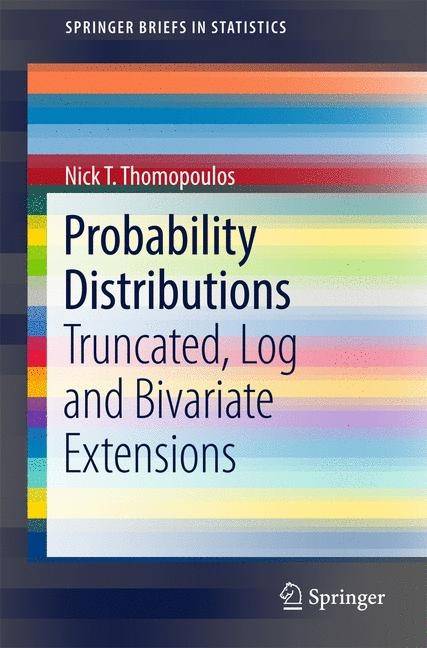
This unique SpringerBrief presents statistical methods and tables not readily available in other publications. It begins with a review of the commonly used continuous and discrete probability distributions. Several useful distributions that are not so common and less understood are described with examples and applications in full detail: discrete normal, left-partial, right-partial, left-truncated normal, right-truncated normal, lognormal, bivariate normal, and bivariate lognormal. Table values are provided with examples that enable researchers to easily apply the distributions to real applications and sample data. The left- and right-truncated normal distributions offer a wide variety of shapes in contrast to the symmetrically shaped normal distribution, and a newly developed spread ratio enables analysts to determine which of the three distributions best fits a particular set of sample data.
Specificaties
Betrokkenen
- Auteur(s):
- Uitgeverij:
Inhoud
- Taal:
- Engels
- Reeks:
Eigenschappen
- Productcode (EAN):
- 9783319519715
- Uitvoering:
- Paperback
- Afmetingen:
- 155 mm x 235 mm


Alleen bij Standaard Boekhandel
+ 106 punten op je klantenkaart van Standaard Boekhandel
Cadeau

AANGERADEN


Beoordelingen
We publiceren alleen reviews die voldoen aan de voorwaarden voor reviews. Bekijk onze voorwaarden voor reviews.