


- Afhalen na 1 uur in een winkel met voorraad
- Gratis thuislevering in België vanaf € 30
- Ruim aanbod met 7 miljoen producten
- Afhalen na 1 uur in een winkel met voorraad
- Gratis thuislevering in België vanaf € 30
- Ruim aanbod met 7 miljoen producten





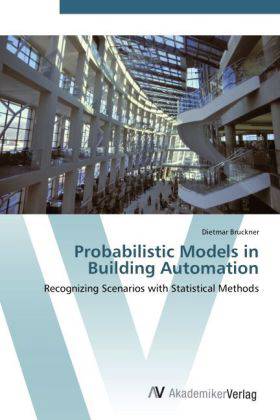
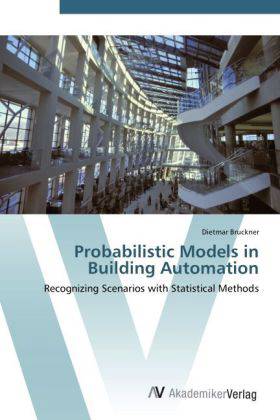
Probabilistic Models in Building Automation
Recognizing Scenarios with Statistical Methods
Dietmar Bruckner
Paperback | Engels
€ 68,45
+ 136 punten
Omschrijving
Revision with unchanged content. The ongoing technological development in the fields of sensors, actuators as well as embedded systems leads to more and more complex and larger building automation systems. These systems allow ever-better observations of activities in buildings with a rapid growing number of possible applications. This work investigates how statistical methods can be applied to (future) building automation systems to recognize erroneous behavior and to extract semantic and context information from sensor data. A hierarchical model structure based on hidden Markov models is proposed to establish a framework for learning about daily routines. The lower levels of the model structure are used to observe the sensor values themselves whereas the higher levels provide a basis for the semantic interpretation of what is happening in the building. This book is of interest for researchers active in science and development of future context aware system for surveillance, observation, or ambient assistance as well as for all individuals interested in trends in building automation.
Specificaties
Betrokkenen
- Auteur(s):
- Uitgeverij:
Inhoud
- Aantal bladzijden:
- 144
- Taal:
- Engels
Eigenschappen
- Productcode (EAN):
- 9783639433449
- Verschijningsdatum:
- 28/06/2012
- Uitvoering:
- Paperback
- Formaat:
- Trade paperback (VS)
- Afmetingen:
- 152 mm x 229 mm
- Gewicht:
- 222 g


Alleen bij Standaard Boekhandel
+ 136 punten op je klantenkaart van Standaard Boekhandel
AANGERADEN


Beoordelingen
We publiceren alleen reviews die voldoen aan de voorwaarden voor reviews. Bekijk onze voorwaarden voor reviews.