



- Afhalen na 1 uur in een winkel met voorraad
- In januari gratis thuislevering in België
- Ruim aanbod met 7 miljoen producten
- Afhalen na 1 uur in een winkel met voorraad
- In januari gratis thuislevering in België
- Ruim aanbod met 7 miljoen producten





€ 107,95
+ 215 punten
Omschrijving
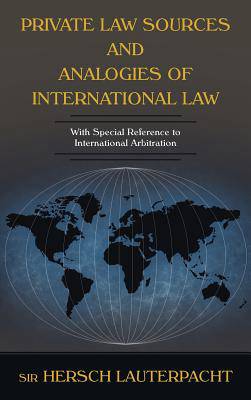
Lauterpacht's influential study uses models drawn from private law for the interpretation and development of international law. Lauterpacht expounds upon this subject with a useful discussion of international arbitration and international tribunals, and refers to numerous cases. Sir Hersch Lauterpacht [1897-1960], one of the greatest scholars of modern international law, was the Whewell Professor of International Law at Cambridge and a judge of the International Court of Justice. The Lauterpacht Centre for International Law at Cambridge University is named in his honor. "Dr. Lauterpacht has made a valuable and scholarly addition to the literature on international law. There has been a good deal of adverse criticism-some of it quite just-on the practice of conducting the argument of a question of international law by pure analogies to civil law. The learned author deprecates the rejection of this mode of reasoning, and develops the thesis that in the great majority of cases its employment has had a beneficial influence on the development of international law. It seems to us that Article 38 (3) of the Statute of the Permanent Court of International Justice, by adopting 'general principles of law recognized by civilized states' as ancillary sources of law for use by the Court, made Dr. Lauterpacht's view not only correct but also inevitable. A book of this kind was bound to come sooner or later, and it is satisfactory that it has been written by one who is an expert." --Percy H. Winfield, Cambridge Law Journal 3 (1927-1929) 322.
Specificaties
Betrokkenen
- Auteur(s):
- Uitgeverij:
Inhoud
- Aantal bladzijden:
- 354
- Taal:
- Engels
Eigenschappen
- Productcode (EAN):
- 9781584771845
- Verschijningsdatum:
- 3/12/2012
- Uitvoering:
- Hardcover
- Formaat:
- Ongenaaid / garenloos gebonden
- Afmetingen:
- 152 mm x 229 mm
- Gewicht:
- 689 g


Alleen bij Standaard Boekhandel
+ 215 punten op je klantenkaart van Standaard Boekhandel
Cadeau

AANGERADEN


Beoordelingen
We publiceren alleen reviews die voldoen aan de voorwaarden voor reviews. Bekijk onze voorwaarden voor reviews.