Standaard Boekhandel gebruikt cookies en gelijkaardige technologieën om de website goed te laten werken en je een betere surfervaring te bezorgen.
Hieronder kan je kiezen welke cookies je wilt inschakelen:
Technische en functionele cookies
Deze cookies zijn essentieel om de website goed te laten functioneren, en laten je toe om bijvoorbeeld in te loggen. Je kan deze cookies niet uitschakelen.
Analytische cookies
Deze cookies verzamelen anonieme informatie over het gebruik van onze website. Op die manier kunnen we de website beter afstemmen op de behoeften van de gebruikers.
Marketingcookies
Deze cookies delen je gedrag op onze website met externe partijen, zodat je op externe platformen relevantere advertenties van Standaard Boekhandel te zien krijgt.
Je kan maximaal 250 producten tegelijk aan je winkelmandje toevoegen. Verwijdere enkele producten uit je winkelmandje, of splits je bestelling op in meerdere bestellingen.
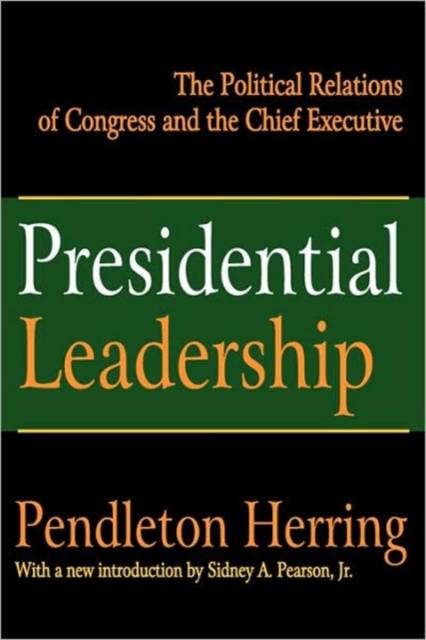
The nature of the presidency is an issue that has been debated since the drafting of the United States Constitution. The Federalists felt a strong executive was the backbone and prime mover of a strong government. On the other side, the Anti-Federalists felt the presidency represented monarchical tendencies and could potentially subvert republican government. How does executive leadership fit in with a limited government with enumerated powers? Does the Constitution require a containment of executive power, even during times of crisis, or do times of crisis warrant an abandonment of a strict legalistic reading of the document?In Presidential Leadership, Pendleton Herring contends that an energetic president is not a threat to existing democratic government "rightly understood." He does not advance an entirely Wilsonian response to the Founders on presidential leadership in which the federal government is seen as a pyramid with the president at its apex, and the British parliamentary system is seen as the model. Nor does he reject the Founders' constitutional design. Rather, Herring's conception of presidential leadership requires an executive who has a mastery of administration. The existing system is sufficiently plastic to be able to cope with any national crisis--but the president must be able to work within that system in the most efficient manner possible.Sidney Pearson, in his comprehensive new introduction to this classic work, shows how Herring merges the views of the Founding Fathers with the Liberal-Progressives. He explains that Herring's model of a strong president is one who knows how to grasp opportunities as they arise, and then use them for the common good. Presidential Leadership is a pioneering study of the American presidency that established the standard for presidential scholarship.