


- Afhalen na 1 uur in een winkel met voorraad
- Gratis thuislevering in België vanaf € 30
- Ruim aanbod met 7 miljoen producten
- Afhalen na 1 uur in een winkel met voorraad
- Gratis thuislevering in België vanaf € 30
- Ruim aanbod met 7 miljoen producten





€ 14,95
+ 29 punten
Omschrijving
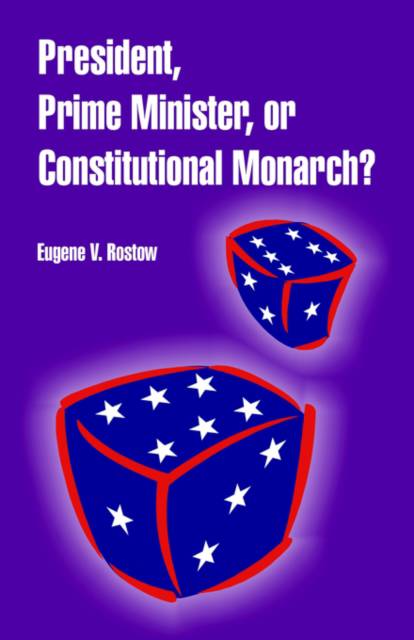
In the making and conduct of foreign policy, Congress and the President have been rivalrous partners for two hundred years. It is not hyperbole to call the current round of that relationship a crisis -the most serious constitutional crisis since President Franklin D. Roosevelt tried to pack the Supreme Court in 1937. Roosevelt's court-packing initiative was highly visible and the reaction to it violent and widespread. It came to an abrupt and dramatic end, some said as the result of Divine intervention, when Senator Joseph T. Robinson, the Senate Majority leader, dropped dead on the floor of the Senate while defending the President's bill. Everyone knew that Robinson hated the proposal, and was speaking for it only as a matter of political duty. The bill was discreetly buried shortly thereafter, the Court having meanwhile adjusted some of its doctrine to the prevailing winds. One justice resigned. The present constitutional crisis cannot be so neatly resolved. It is insidious, diffuse, and largely invisible, like the early stages of a cancer. Its roots are deep, and it has been spreading at an accelerating pace since 1932, when the legislative veto was invented. Few people realize that a crisis is going on, particularly because congressional accretions of power are invariably explained as moves to take back legislative prerogatives recently seized by a succession of "imperial" Presidents. Congress' thrust for dominion has not so far aroused much political resistance, and the professional writing on the subject has been largely an apology for the claims of Congress. Many members of Congress are concerned about the constitutional implications of what they are doing, but institutional or political loyalties constrain most of them from speaking out. While Congress' attempt to control foreign policy is only part of a wider congressional assault on the authority of the Executive, it is more acute than the struggle on other fronts because public concern over foreign affairs is more anxiously aroused than is the case for most other issues of public policy. The role of the President in relation to Congress on foreign policy is inherently more prominent than it is, for example, on tax policy. Furthermore, after Korea and Vietnam, the nation is no longer so strongly united in supporting the foreign policy initiated forty years ago by President Truman and Secretary of State Acheson, and followed in broad outline by all the Presidents and by Congress since that time.
Specificaties
Betrokkenen
- Auteur(s):
- Uitgeverij:
Inhoud
- Aantal bladzijden:
- 56
- Taal:
- Engels
Eigenschappen
- Productcode (EAN):
- 9781410219688
- Verschijningsdatum:
- 25/01/2005
- Uitvoering:
- Paperback
- Formaat:
- Trade paperback (VS)
- Afmetingen:
- 140 mm x 216 mm
- Gewicht:
- 81 g



Alleen bij Standaard Boekhandel
+ 29 punten op je klantenkaart van Standaard Boekhandel
AANGERADEN


Beoordelingen
We publiceren alleen reviews die voldoen aan de voorwaarden voor reviews. Bekijk onze voorwaarden voor reviews.