


- Afhalen na 1 uur in een winkel met voorraad
- Gratis thuislevering in België vanaf € 30
- Ruim aanbod met 7 miljoen producten
- Afhalen na 1 uur in een winkel met voorraad
- Gratis thuislevering in België vanaf € 30
- Ruim aanbod met 7 miljoen producten





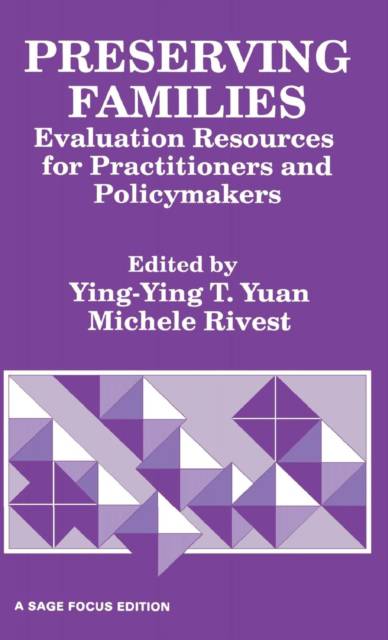
Preserving Families
Evaluation Resources for Practitioners and Policymakers
€ 358,95
+ 717 punten
Omschrijving
Providing excellent insights into evaluation, Preserving Families examines the issues related to describing and evaluating social programs for families and children. The focus is on keeping the family intact, rather than those programs that emphasize removing the child from the family setting. The contributors offer an in-depth discussion of program features that are important for conducting an evaluation, including program description, target populations, client outcomes, cost analysis, and evaluation design. Each chapter raises issues that are pertinent to designing a comprehensive or a special focus study, including a detailed description of program components. Preserving Families is an essential tool for understanding policy analysis and program evaluation, and also provides practical case materials for classroom instruction. "The monograph offers a number of suggestions and illustrations for making evaluations relevant to ′real world′ policymakers and program managers. . . . [It] is a great tool that will help demystify evaluation . . . [and] will help people in the family preservation field--and in related fields--feel competent in helping define and shape the evaluation agenda in ways that will produce useful and usable findings. . . . [It] provides great case material for classroom instruction in program evaluation and policy analysis." --Sandy M. O′Donnell, Roosevelt University "Offers a comprehensive assessment of evaluation resources for practitioners and policy makers. It provides a sound overview of the uses of evaluation, as well the construction of study designs, including defining a target population, fitting evealuation to a program environment, appraising outcome measures, and cost analysis. This collection is valuable to any professional working in the field of family-based, home-based or family preservation services." --Family-Based Resource Review "[The editors] have succeeded in providing a volume that will be helpful not only to family service evaluators and administrators but also to family policy instructors and researchers." --Journal of Marriage and the Family "This manual makes an invaluable contribution to the family preservation movement, the centerpiece of child welfare reform. This comprehensive ′how to,′ step-by-step guide arrives at a crucial time: [meeting] a growing demand for evaluation for family preservation services. Experts in the child welfare and mental health fields have provided a pertinent and easily understood response to an urgent question: How can a design for an evaluation be produced that will provide reliable data for practitioners, administrators, and policymakers?" --Esther Wattenberg, University of Minnesota "Provides the most current information on crisis-intervention work with high-risk, multiproblem families. . . . For readers interested in program evaluation of family preservation services, the book is a must. . . . Read Preserving Families for thoughtful, practical suggestions relative to evaluating family preservation programs." --Journal of Marital and Family Therapy "The importance of accurate and available evaluation to social policy formulation is a critical issue that is often ignored because this type of research is generally lacking. Special research techniques and methods need to be considered in order to answer policy questions. This book is an important contribution to that end. The methods and techniques described by these authors are certainly applicable to other social service policy areas as well. Clearly written, this is a volume for hands-on planners and evaluators; it is not intimidating, nor is it condescending." --Family Relations
Specificaties
Betrokkenen
- Uitgeverij:
Inhoud
- Aantal bladzijden:
- 176
- Taal:
- Engels
- Reeks:
- Reeksnummer:
- nr. 117
Eigenschappen
- Productcode (EAN):
- 9780803936850
- Verschijningsdatum:
- 1/04/1990
- Uitvoering:
- Hardcover
- Formaat:
- Genaaid
- Afmetingen:
- 140 mm x 216 mm
- Gewicht:
- 344 g

Alleen bij Standaard Boekhandel
+ 717 punten op je klantenkaart van Standaard Boekhandel
Cadeau

AANGERADEN


Beoordelingen
We publiceren alleen reviews die voldoen aan de voorwaarden voor reviews. Bekijk onze voorwaarden voor reviews.