


- Afhalen na 1 uur in een winkel met voorraad
- Gratis thuislevering in België vanaf € 30
- Ruim aanbod met 7 miljoen producten
- Afhalen na 1 uur in een winkel met voorraad
- Gratis thuislevering in België vanaf € 30
- Ruim aanbod met 7 miljoen producten





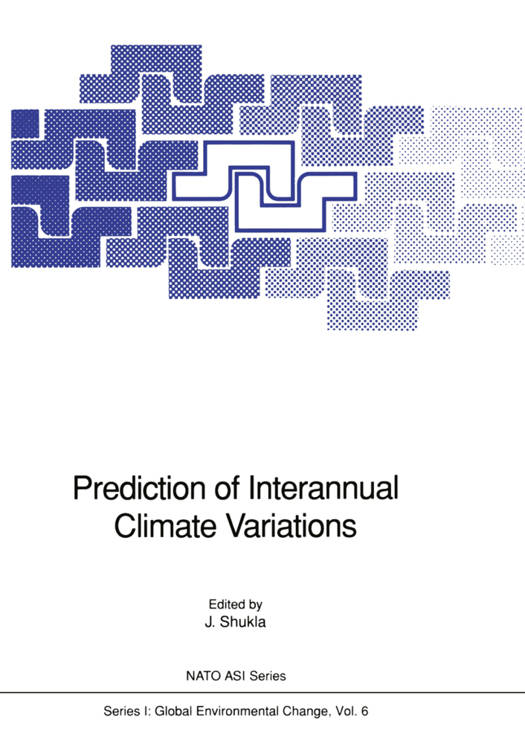
Prediction of Interannual Climate Variations
€ 106,95
+ 213 punten
Omschrijving
It has been known for some time that the behavior of the short-term fluctuations of the earth's atmosphere resembles that of a chaotic non-linear dynamical system, and that the day-to-day weather cannot be predicted beyond a few weeks. However, it has also been found that the interactions of the atmosphere with the underlying oceans and the land surfaces can produce fluctuations whose time scales are much longer than the limits of deterministic prediction of weather. It is, therefore, natural to ask whether it is possible that the seasonal and longer time averages of climate fluctuations can be predicted with sufficient skill to be beneficial for social and economic applications, even though the details of the day-to-day weather cannot be predicted beyond a few weeks. The main objective of the workshop was to address this question by assessing the current state of knowledge on predictability of seasonal and interannual climate variability and to investigate various possibilities for its prediction.
Specificaties
Betrokkenen
- Uitgeverij:
Inhoud
- Aantal bladzijden:
- 265
- Taal:
- Engels
- Reeks:
- Reeksnummer:
- nr. 6
Eigenschappen
- Productcode (EAN):
- 9783642769627
- Verschijningsdatum:
- 16/12/2011
- Uitvoering:
- Paperback
- Formaat:
- Trade paperback (VS)
- Afmetingen:
- 170 mm x 244 mm
- Gewicht:
- 453 g

Alleen bij Standaard Boekhandel
+ 213 punten op je klantenkaart van Standaard Boekhandel
Cadeau

AANGERADEN


Beoordelingen
We publiceren alleen reviews die voldoen aan de voorwaarden voor reviews. Bekijk onze voorwaarden voor reviews.