



- Afhalen na 1 uur in een winkel met voorraad
- In januari gratis thuislevering in België
- Ruim aanbod met 7 miljoen producten
- Afhalen na 1 uur in een winkel met voorraad
- In januari gratis thuislevering in België
- Ruim aanbod met 7 miljoen producten





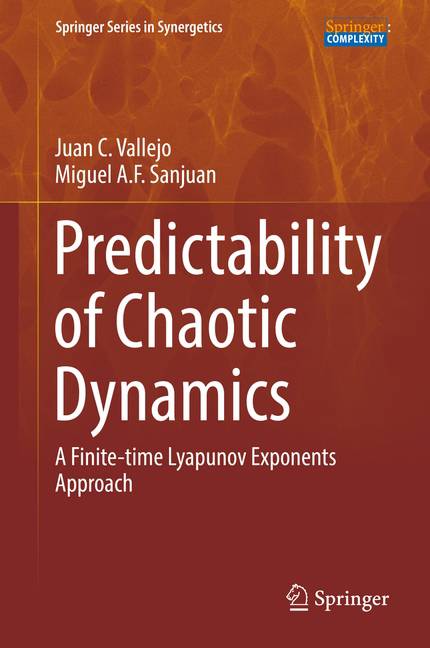
Predictability of Chaotic Dynamics
A Finite-time Lyapunov Exponents Approach
Miguel A. F. Sanjuan, Juan C. Vallejo
€ 84,47
+ 168 punten
Omschrijving
This book is primarily concerned with the computational aspects of predictability of dynamical systems - in particular those where observation, modeling and computation are strongly interdependent. Unlike with physical systems under control in laboratories, for instance in celestial mechanics, one is confronted with the observation and modeling of systems without the possibility of altering the key parameters of the objects studied. Therefore, the numerical simulations offer an essential tool for analyzing these systems.
With the widespread use of computer simulations to solve complex dynamical systems, the reliability of the numerical calculations is of ever-increasing interest and importance. This reliability is directly related to the regularity and instability properties of the modeled flow. In this interdisciplinary scenario, the underlying physics provide the simulated models, nonlinear dynamics provides their chaoticity and instability properties, and the computer sciences provide the actual numerical implementation.
This book introduces and explores precisely this link between the models and their predictability characterization based on concepts derived from the field of nonlinear dynamics, with a focus on the finite-time Lyapunov exponents approach. The method is illustrated using a number of well-known continuous dynamical systems, including the Contopoulos, Hénon-Heiles and Rössler systems. To help students and newcomers quickly learn to apply these techniques, the appendix provides descriptions of the algorithms used throughout the text and details how to implement them in order to solve a given continuous dynamical system.
With the widespread use of computer simulations to solve complex dynamical systems, the reliability of the numerical calculations is of ever-increasing interest and importance. This reliability is directly related to the regularity and instability properties of the modeled flow. In this interdisciplinary scenario, the underlying physics provide the simulated models, nonlinear dynamics provides their chaoticity and instability properties, and the computer sciences provide the actual numerical implementation.
This book introduces and explores precisely this link between the models and their predictability characterization based on concepts derived from the field of nonlinear dynamics, with a focus on the finite-time Lyapunov exponents approach. The method is illustrated using a number of well-known continuous dynamical systems, including the Contopoulos, Hénon-Heiles and Rössler systems. To help students and newcomers quickly learn to apply these techniques, the appendix provides descriptions of the algorithms used throughout the text and details how to implement them in order to solve a given continuous dynamical system.
Specificaties
Betrokkenen
- Auteur(s):
- Uitgeverij:
Inhoud
- Aantal bladzijden:
- 136
- Taal:
- Engels
- Reeks:
Eigenschappen
- Productcode (EAN):
- 9783319518923
- Verschijningsdatum:
- 22/05/2017
- Uitvoering:
- Hardcover
- Afmetingen:
- 163 mm x 15 mm
- Gewicht:
- 350 g



Alleen bij Standaard Boekhandel
+ 168 punten op je klantenkaart van Standaard Boekhandel
Cadeau

AANGERADEN


Beoordelingen
We publiceren alleen reviews die voldoen aan de voorwaarden voor reviews. Bekijk onze voorwaarden voor reviews.