


- Afhalen na 1 uur in een winkel met voorraad
- Gratis thuislevering in België vanaf € 30
- Ruim aanbod met 7 miljoen producten
- Afhalen na 1 uur in een winkel met voorraad
- Gratis thuislevering in België vanaf € 30
- Ruim aanbod met 7 miljoen producten





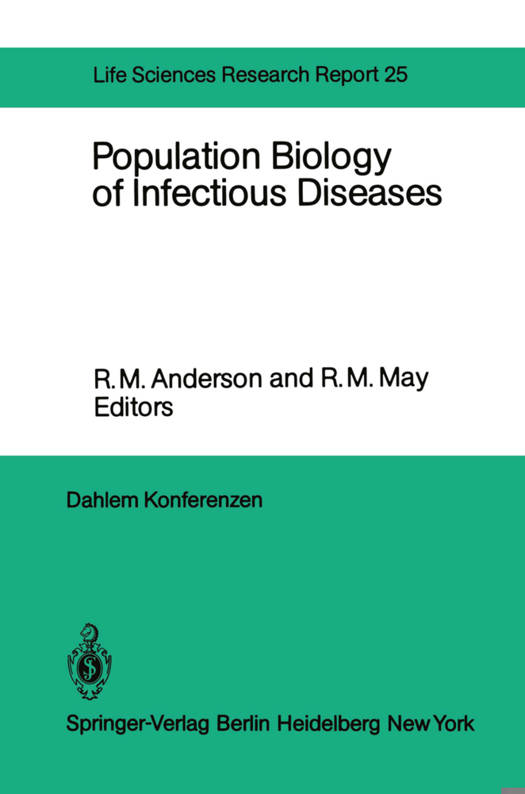
Population Biology of Infectious Diseases
Report of the Dahlem Workshop on Population Biology of Infectious Disease Agents Berlin 1982, March 14 - 19
€ 150,48
+ 300 punten
Omschrijving
for the design of control programs; in extreme cases (as dis- cussed below, by Fine et al., this volume, and elsewhere) it can happen that immunization programs, although they protect vaccinated individuals, actually increase the overall incidence of a particular disease. The possibility that many nonhuman animal populations may be regulated by parasitic infections is another topic where it may be argued that conventional disciplinary boundaries have retarded investigation. While much ecological research has been devoted to exploring the extent to which competition or predator-prey interactions may regulate natural populations or set their patterns of geographical distribution, few substan- tial studies have considered the possibility that infectious diseases may serve as regulatory agents (1,8). On the other hand, the many careful epidemiological studies of the trans- mission and maintenance of parasitic infections in human and other animal populations usually assume the host population density to be set by other considerations, and not dynamically engaged with the disease (see, for example, (1,2)). With all these considerations in mind, the Dahlem Workshop from which this book derives aimed to weave strands together -- testing theoretical analysis against empirical facts and patterns, and identifying outstanding problems -- in pursuit of a better un- derstanding of the overall population biology of parasitic in- fections. For the purpose of the workshop, the term "parasite" was de- fined widely to include viruses, bacteria, protozoans, fungi, and helminths.
Specificaties
Betrokkenen
- Uitgeverij:
Inhoud
- Aantal bladzijden:
- 316
- Taal:
- Engels
- Reeks:
- Reeksnummer:
- nr. 25
Eigenschappen
- Productcode (EAN):
- 9783642686375
- Verschijningsdatum:
- 21/11/2011
- Uitvoering:
- Paperback
- Formaat:
- Trade paperback (VS)
- Afmetingen:
- 152 mm x 229 mm
- Gewicht:
- 439 g


Alleen bij Standaard Boekhandel
+ 300 punten op je klantenkaart van Standaard Boekhandel

Beoordelingen
We publiceren alleen reviews die voldoen aan de voorwaarden voor reviews. Bekijk onze voorwaarden voor reviews.