


- Afhalen na 1 uur in een winkel met voorraad
- Gratis thuislevering in België vanaf € 30
- Ruim aanbod met 7 miljoen producten
- Afhalen na 1 uur in een winkel met voorraad
- Gratis thuislevering in België vanaf € 30
- Ruim aanbod met 7 miljoen producten





€ 116,95
+ 233 punten
Uitvoering
Omschrijving
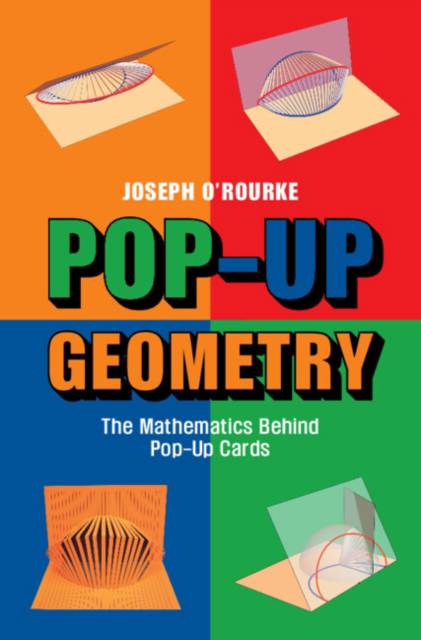
Anyone browsing at the stationery store will see an incredible array of pop-up cards available for any occasion. The workings of pop-up cards and pop-up books can be remarkably intricate. Behind such designs lies beautiful geometry involving the intersection of circles, cones, and spheres, the movements of linkages, and other constructions. The geometry can be modelled by algebraic equations, whose solutions explain the dynamics. For example, several pop-up motions rely on the intersection of three spheres, a computation made every second for GPS location. Connecting the motions of the card structures with the algebra and geometry reveals abstract mathematics performing tangible calculations. Beginning with the nephroid in the 19th-century, the mathematics of pop-up design is now at the frontiers of rigid origami and algorithmic computational complexity. All topics are accessible to those familiar with high-school mathematics; no calculus required. Explanations are supplemented by 140+ figures and 20 animations.
Specificaties
Betrokkenen
- Auteur(s):
- Uitgeverij:
Inhoud
- Aantal bladzijden:
- 142
- Taal:
- Engels
Eigenschappen
- Productcode (EAN):
- 9781009098403
- Verschijningsdatum:
- 24/03/2022
- Uitvoering:
- Hardcover
- Formaat:
- Genaaid
- Afmetingen:
- 152 mm x 229 mm
- Gewicht:
- 362 g


Alleen bij Standaard Boekhandel
+ 233 punten op je klantenkaart van Standaard Boekhandel
Cadeau

AANGERADEN


Beoordelingen
We publiceren alleen reviews die voldoen aan de voorwaarden voor reviews. Bekijk onze voorwaarden voor reviews.