


- Afhalen na 1 uur in een winkel met voorraad
- Gratis thuislevering in België vanaf € 30
- Ruim aanbod met 7 miljoen producten
- Afhalen na 1 uur in een winkel met voorraad
- Gratis thuislevering in België vanaf € 30
- Ruim aanbod met 7 miljoen producten





€ 369,59
+ 739 punten
Omschrijving
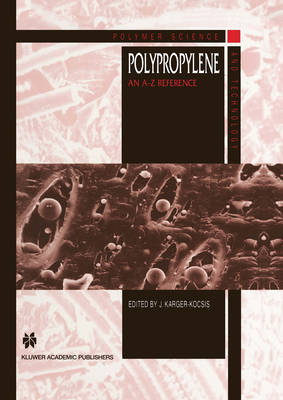
My heart sank when I was approached by Dr Hastings and by Professor Briggs (Senior Editor of Materials Science and Technology and Series Editor of Polymer Science and Technology Series at Chapman & Hall, respectively) to edit a book with the provisional title Handbook of Poly- propylene. My reluctance was due to the fact that my former book [1] along with that of Moore [2], issued in the meantime, seemed to cover the information demand on polypropylene and related systems. Encour- aged, however, by some colleagues (the new generation of scientists and engineers needs a good reference book with easy information retrieval, and the development with metallocene catalysts deserves a new update!), I started on this venture. Having some experience with polypropylene systems and being aware of the current literature, it was easy to settle the titles for the book chapters and also to select and approach the most suitable potential contributors. Fortunately, many of my first-choice authors accepted the invitation to contribute. Like all editors of multi-author volumes, I recognize that obtaining contributors follows an S-type curve of asymptotic saturation when the number of willing contributors is plotted as a function of time. The saturation point is, however, never reached and as a consequence, Dear Reader, you will also find some topics of some relevance which are not explicitly treated in this book (but, believe me, I have considered them).
Specificaties
Betrokkenen
- Uitgeverij:
Inhoud
- Aantal bladzijden:
- 966
- Taal:
- Engels
- Reeks:
- Reeksnummer:
- nr. 2
Eigenschappen
- Productcode (EAN):
- 9789401058995
- Verschijningsdatum:
- 22/11/2012
- Uitvoering:
- Paperback
- Formaat:
- Trade paperback (VS)
- Afmetingen:
- 210 mm x 297 mm
- Gewicht:
- 2607 g

Alleen bij Standaard Boekhandel
+ 739 punten op je klantenkaart van Standaard Boekhandel
AANGERADEN


Beoordelingen
We publiceren alleen reviews die voldoen aan de voorwaarden voor reviews. Bekijk onze voorwaarden voor reviews.