



Je cadeautjes zeker op tijd in huis hebben voor de feestdagen? Kom langs in onze winkels en vind het perfecte geschenk!
- Afhalen na 1 uur in een winkel met voorraad
- Gratis thuislevering in België vanaf € 30
- Ruim aanbod met 7 miljoen producten
Je cadeautjes zeker op tijd in huis hebben voor de feestdagen? Kom langs in onze winkels en vind het perfecte geschenk!
- Afhalen na 1 uur in een winkel met voorraad
- Gratis thuislevering in België vanaf € 30
- Ruim aanbod met 7 miljoen producten





Omschrijving
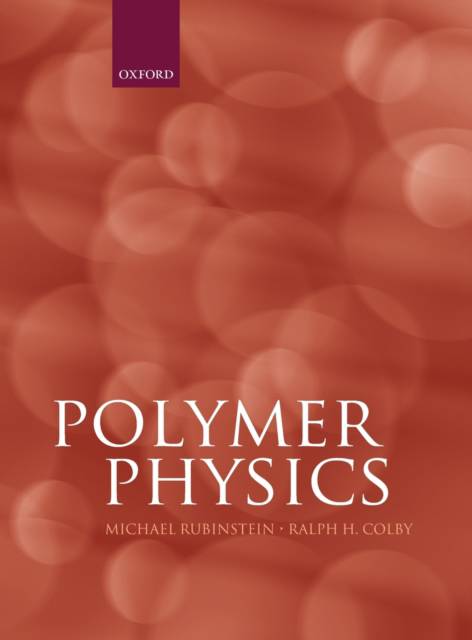
This is a polymer physics textbook for upper level undergraduates and first year graduate students. Any student with a working knowledge of calculus, physics and chemistry should be able to read this book. The essential tools of the polymer physical chemist or engineer are derived in this book without skipping any steps. The book is a self-contained treatise that could also serve as a useful reference for scientists and engineers working with polymers. While no prior knowledge of polymers is assumed, the book goes far beyond introductory polymer texts in the scope of what is covered. The fundamental concepts required to fully understand polymer melts, solutions and gels in terms of both static structure and dynamics are explained in detail. Problems at the end of each Chapter provide the reader with the opportunity to apply what has been learned to practice. The book is divided into four parts. After an introduction in Chapter 1, where the necessary concepts from a first course on polymers are summarized, the conformations of single polymer chains are treated in Part 1. Part 2 deals with the thermodynamics of polymer solutions and melts, including the conformations of chains in those states. Part 3 applies the concepts of Part 2 to the formation and properties of polymer networks. Finally, Part 4 explains the essential aspects of how polymers move in both melt and solution states. In all cases, attention is restricted to concepts that are firmly entrenched in the field.
Specificaties
Betrokkenen
- Auteur(s):
- Uitgeverij:
Inhoud
- Aantal bladzijden:
- 456
- Taal:
- Engels
- Reeks:
Eigenschappen
- Productcode (EAN):
- 9780198520597
- Verschijningsdatum:
- 7/08/2003
- Uitvoering:
- Hardcover
- Formaat:
- Genaaid
- Afmetingen:
- 189 mm x 256 mm
- Gewicht:
- 1202 g



Alleen bij Standaard Boekhandel
CADEAU


Beoordelingen
We publiceren alleen reviews die voldoen aan de voorwaarden voor reviews. Bekijk onze voorwaarden voor reviews.