



Bedankt voor het vertrouwen het afgelopen jaar! Om jou te bedanken bieden we GRATIS verzending (in België) aan op alles gedurende de hele maand januari.
- Afhalen na 1 uur in een winkel met voorraad
- In januari gratis thuislevering in België
- Ruim aanbod met 7 miljoen producten
Bedankt voor het vertrouwen het afgelopen jaar! Om jou te bedanken bieden we GRATIS verzending (in België) aan op alles gedurende de hele maand januari.
- Afhalen na 1 uur in een winkel met voorraad
- In januari gratis thuislevering in België
- Ruim aanbod met 7 miljoen producten





Omschrijving
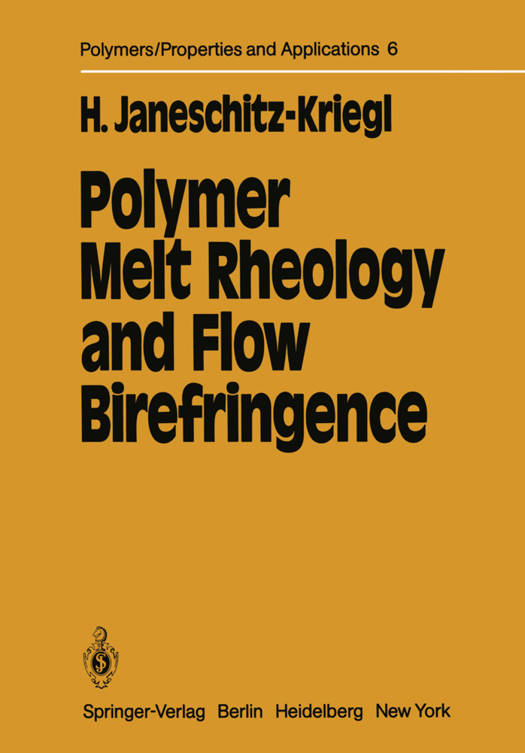
The present monograph is intended as an introduction into a field which certainly did not receive proper attention in the past. It is one of the aims of this book to verify this suppo- sition. The author hopes to show that the technique of the measurement of flow birefringence can fulfil an important com- plementary task in polymer melt rheology. From this point it is expected that the present monograph will attract the atten- tion of polymer scientists in general, and of rheologists and process engineers in particular. Certainly, the fourth chapter will appeal to the latter group. As a teacher in polymer science and technology the author wants to address also the group of the graduate students. In fact, the standard knowledge acquired during usual university studies in chemistry, physics or engineering does not enable a quick start of research activities in the field of polymer melt rheology. Certainly, in this typically interdisciplinary field everyone can lay emphasis on matters which are familar to hirn because of his preceding education. Significant research activities, however, can only be generated on the basis of a more universal knowledge. In the absence of this knowledge beginners have to rely upon the guidance of their supervisors for an unduly long period. Otherwise they take the risk of losing too much of their costly time. This holds in particular for the experimentalists who cannot be dispensed from being familiar with the necessary theoretical background.
Specificaties
Betrokkenen
- Auteur(s):
- Uitgeverij:
Inhoud
- Aantal bladzijden:
- 524
- Taal:
- Engels
- Reeks:
- Reeksnummer:
- nr. 6
Eigenschappen
- Productcode (EAN):
- 9783642688249
- Verschijningsdatum:
- 6/12/2011
- Uitvoering:
- Paperback
- Formaat:
- Trade paperback (VS)
- Afmetingen:
- 170 mm x 244 mm
- Gewicht:
- 857 g


Alleen bij Standaard Boekhandel
+ 335 punten op je klantenkaart van Standaard Boekhandel
SOLDEN


Beoordelingen
We publiceren alleen reviews die voldoen aan de voorwaarden voor reviews. Bekijk onze voorwaarden voor reviews.