


- Afhalen na 1 uur in een winkel met voorraad
- Gratis thuislevering in België vanaf € 30
- Ruim aanbod met 7 miljoen producten
- Afhalen na 1 uur in een winkel met voorraad
- Gratis thuislevering in België vanaf € 30
- Ruim aanbod met 7 miljoen producten





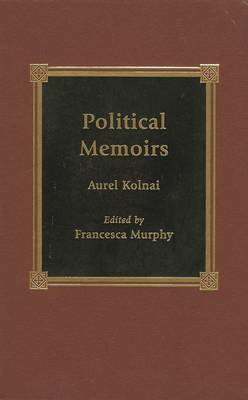
Political Memoirs
Aurel Kolnai
€ 254,45
+ 508 punten
Omschrijving
Ranked by many scholars as one of the most important moral philosophers of the twentieth century, Aurel Kolnai has been inexplicably neglected in this country until quite recently. He is best known for his works of political philosophy, recently published under the title The Utopian Mind: A Critical Study in Moral and Political Philosophy. Here, for the first time ever in English, is Kolnai's magnum opus, his Political Memoirs, superbly annotated and edited by Francesca Murphy of the University of Aberdeen, Scotland. The memoirs recount the author's life, from his childhood in the turn-of-the-century Austro-Hungarian Empire to his education in Germany and his early professional life in prewar Vienna. It was in these formative years that he converted from Judaism to Roman Catholicism and began his career as a writer and philosopher. The narrative continues through his years in exile in the United States and Canada, where he lived before ultimately settling in Great Britain and being granted citizenship in 1955.
Specificaties
Betrokkenen
- Auteur(s):
- Uitgeverij:
Inhoud
- Aantal bladzijden:
- 304
- Taal:
- Engels
- Reeks:
Eigenschappen
- Productcode (EAN):
- 9780739100653
- Verschijningsdatum:
- 3/11/1999
- Uitvoering:
- Hardcover
- Formaat:
- Genaaid
- Afmetingen:
- 155 mm x 235 mm
- Gewicht:
- 512 g


Alleen bij Standaard Boekhandel
+ 508 punten op je klantenkaart van Standaard Boekhandel
Cadeau

AANGERADEN


Beoordelingen
We publiceren alleen reviews die voldoen aan de voorwaarden voor reviews. Bekijk onze voorwaarden voor reviews.