


- Afhalen na 1 uur in een winkel met voorraad
- Gratis thuislevering in België vanaf € 30
- Ruim aanbod met 7 miljoen producten
- Afhalen na 1 uur in een winkel met voorraad
- Gratis thuislevering in België vanaf € 30
- Ruim aanbod met 7 miljoen producten





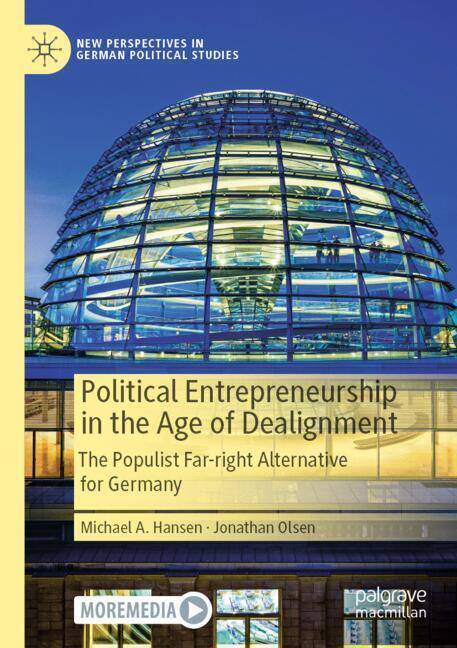
Political Entrepreneurship in the Age of Dealignment
The Populist Far-Right Alternative for Germany
Michael A. Hansen, Jonathan Olsen
€ 140,95
+ 281 punten
Uitvoering
Omschrijving
This book traces the rise of the far-right Alternative for Germany (AfD) from its inception in 2013 to its re-election to the Bundestag in 2021, emphasising the party's nature as a "populist issue entrepreneur" and covering the three major crises that have shaken European party politics - the Eurozone crisis, the so-called refugee crisis and the COVID pandemic. Currently, books on the AfD are largely limited to historical accounts and surface-level analyses of the party. This volume is both empirically rigorous and conceptually nuanced: it seeks to understand the party's political trajectory and its appeal to its supporters by using advanced quantitative methodologies to analyse voter behaviour, as well as by interpreting the party's communication strategies through mixed empirical methods. It embeds this account within a well-grounded theoretical argument. The argument emphasises three important explanatory conditions - a favourable political opportunity structure, issue entrepreneurship, and the party's stages of political development.
Specificaties
Betrokkenen
- Auteur(s):
- Uitgeverij:
Inhoud
- Taal:
- Engels
- Reeks:
Eigenschappen
- Productcode (EAN):
- 9783031508929
- Uitvoering:
- Paperback
- Afmetingen:
- 148 mm x 13 mm
- Gewicht:
- 306 g



Alleen bij Standaard Boekhandel
+ 281 punten op je klantenkaart van Standaard Boekhandel
Cadeau

AANGERADEN


Beoordelingen
We publiceren alleen reviews die voldoen aan de voorwaarden voor reviews. Bekijk onze voorwaarden voor reviews.