


- Afhalen na 1 uur in een winkel met voorraad
- Gratis thuislevering in België vanaf € 30
- Ruim aanbod met 7 miljoen producten
- Afhalen na 1 uur in een winkel met voorraad
- Gratis thuislevering in België vanaf € 30
- Ruim aanbod met 7 miljoen producten





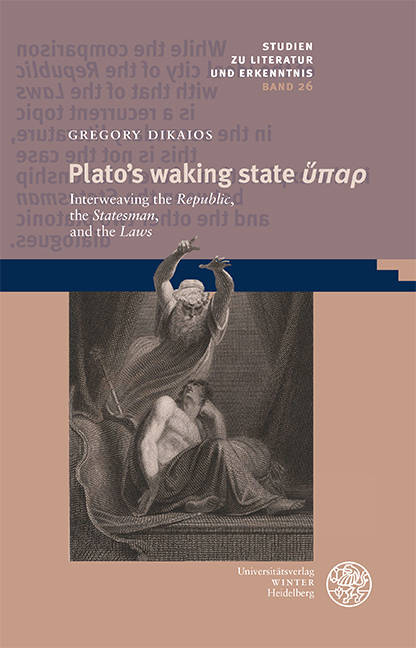
Plato's waking state pi
Interweaving the 'Republic', the 'Statesman', and the 'Laws'
Gregory Dikaios
€ 53,45
+ 106 punten
Omschrijving
Grigorios Dikaios seeks a new answer to the old and highly controversial question of how Plato's three major dialogues - 'Republic', 'Statesman', and 'Laws' - relate to one another. Are the 'Laws', Plato's late masterwork, (not) a refutation of the theses defended in the 'Republic'? Is the 'Statesman' a bridging dialogue - a bridge between 'Republic' and 'Laws'? Why is Socrates entirely absent from the 'Laws'? Drawing on the often overlooked distinction between dreaming and waking state ( ni / ni ni vs. pi ) and the double meaning of pi d Gammami (model and example), Dikaios reconsiders the epistemological and political background between these dialogues. Just as the weaver in the 'Statesman' interlaces warp and woof, this study attempts to interweave and simultaneously distinguish central aspects of the three dialogues - enabling a comparison from the 'Republic' to the 'Laws' and back from the 'Laws' to the 'Republic', from end to beginning and from beginning to end.
Specificaties
Betrokkenen
- Auteur(s):
- Uitgeverij:
Inhoud
- Aantal bladzijden:
- 287
- Taal:
- Engels
- Reeks:
- Reeksnummer:
- nr. 26
Eigenschappen
- Productcode (EAN):
- 9783825397067
- Verschijningsdatum:
- 6/11/2025
- Uitvoering:
- Hardcover
- Afmetingen:
- 163 mm x 22 mm
- Gewicht:
- 605 g


Alleen bij Standaard Boekhandel
+ 106 punten op je klantenkaart van Standaard Boekhandel
Wedstrijd


Beoordelingen
We publiceren alleen reviews die voldoen aan de voorwaarden voor reviews. Bekijk onze voorwaarden voor reviews.