


- Afhalen na 1 uur in een winkel met voorraad
- Gratis thuislevering in België vanaf € 30
- Ruim aanbod met 7 miljoen producten
- Afhalen na 1 uur in een winkel met voorraad
- Gratis thuislevering in België vanaf € 30
- Ruim aanbod met 7 miljoen producten





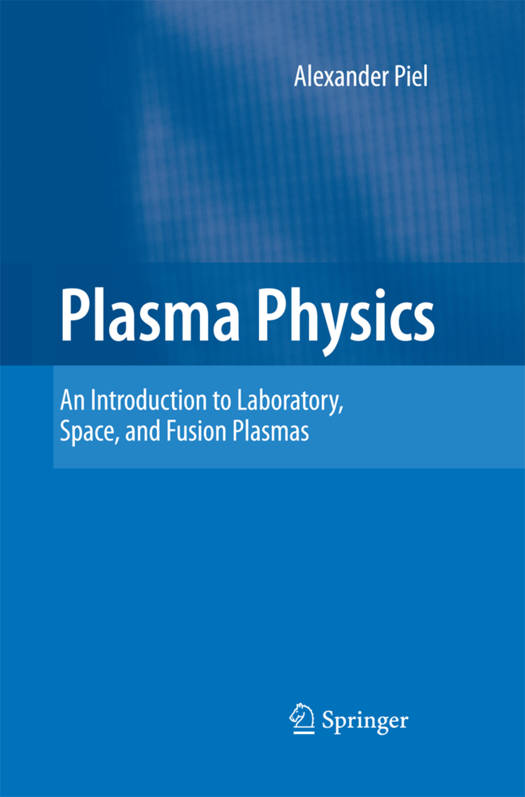
Plasma Physics
An Introduction to Laboratory, Space, and Fusion Plasmas
Alexander Piel
Paperback | Engels
€ 65,95
+ 131 punten
Uitvoering
Eenvoudig bestellen
Veilig betalen


Gratis thuislevering vanaf € 30 (via bpost)
Gratis levering in je Standaard Boekhandel
Omschrijving
This book is an outgrowth of courses in plasma physics which I have taught at Kiel University for many years. During this time I have tried to convince my students that plasmas as different as gas dicharges, fusion plasmas and space plasmas can be described in a uni ed way by simple models. The challenge in teaching plasma physics is its apparent complexity. The wealth of plasma phenomena found in so diverse elds makes it quite different from atomic physics, where atomic structure, spectral lines and chemical binding can all be derived from a single equation--the Schrödinger equation. I positively accept the variety of plasmas and refrain from subdividing plasma physics into the traditional, but arti cially separated elds, of hot, cold and space plasmas. This is why I like to confront my students, and the readers of this book, with examples from so many elds. By this approach, I believe, they will be able to become discoverers who can see the commonality between a falling apple and planetary motion. As an experimentalist, I am convinced that plasma physics can be best understood from a bottom-up approach with many illustrating examples that give the students con dence in their understanding of plasma processes. The theoretical framework of plasma physics can then be introduced in several steps of re nement. In the end, the student (or reader) will see that there is something like the Schrödinger equation, namely the Vlasov-Maxwell model of plasmas, from which nearly all phenomena in collisionless plasmas can be derived.
Specificaties
Betrokkenen
- Auteur(s):
- Uitgeverij:
Inhoud
- Aantal bladzijden:
- 398
- Taal:
- Engels
Eigenschappen
- Productcode (EAN):
- 9783642436314
- Verschijningsdatum:
- 14/11/2014
- Uitvoering:
- Paperback
- Formaat:
- Trade paperback (VS)
- Afmetingen:
- 156 mm x 234 mm
- Gewicht:
- 580 g


Alleen bij Standaard Boekhandel
+ 131 punten op je klantenkaart van Standaard Boekhandel
CADEAU

AANGERADEN


Beoordelingen
We publiceren alleen reviews die voldoen aan de voorwaarden voor reviews. Bekijk onze voorwaarden voor reviews.