



Bedankt voor het vertrouwen het afgelopen jaar! Om jou te bedanken bieden we GRATIS verzending (in België) aan op alles gedurende de hele maand januari.
- Afhalen na 1 uur in een winkel met voorraad
- In januari gratis thuislevering in België
- Ruim aanbod met 7 miljoen producten
Bedankt voor het vertrouwen het afgelopen jaar! Om jou te bedanken bieden we GRATIS verzending (in België) aan op alles gedurende de hele maand januari.
- Afhalen na 1 uur in een winkel met voorraad
- In januari gratis thuislevering in België
- Ruim aanbod met 7 miljoen producten





Omschrijving
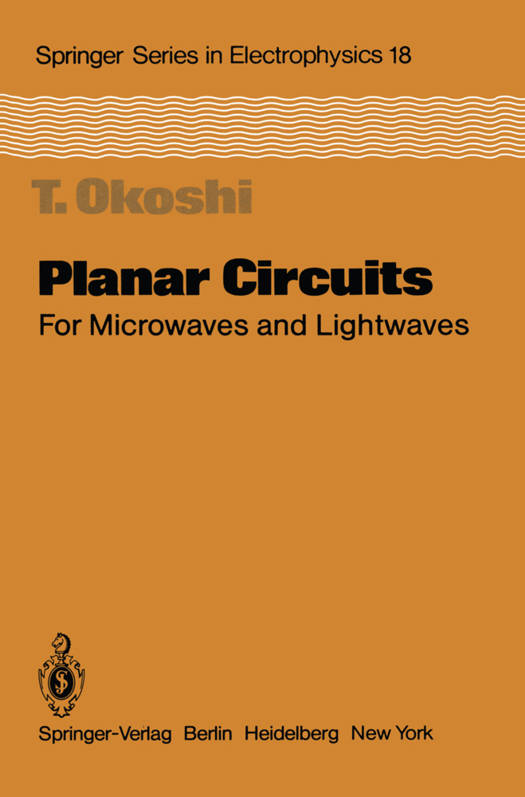
Until recently, three principal classes had been known in the electrical cir- cuitry. They were as follows: 1) The lumped-constant circuit, which should be called a zero-dimensional circuit, in the sense that the circuit elements are much smaller in size as compared with the wavelength in all three spatial directions. 2) The distributed-constant circuit, which should be called a one-dimensional circuit, in the sense that the circuit elements are much smaller than the wavelength in two directions but comparable to the wavelength in one di- rection. 3) The waveguide circuit, which should be called a three-dimensional circuit, in the sense that the circuit elements are comparable to the wavelength in all three directions. The principal subject of this book is the analysis and design (synthesis) theories for another circuit class which appeared in the late 1960s and became common in the 1970s. This new circuit class is 4) the planar circuit, which should be called a two-dimensional circuit, in the sense that the circuit elements are much smaller in size as compared with the wavelength in one direction, but comparable to the wavelength in the other two directions.
Specificaties
Betrokkenen
- Auteur(s):
- Uitgeverij:
Inhoud
- Aantal bladzijden:
- 202
- Taal:
- Engels
- Reeks:
- Reeksnummer:
- nr. 18
Eigenschappen
- Productcode (EAN):
- 9783642700859
- Verschijningsdatum:
- 17/11/2011
- Uitvoering:
- Paperback
- Formaat:
- Trade paperback (VS)
- Afmetingen:
- 156 mm x 234 mm
- Gewicht:
- 322 g


Alleen bij Standaard Boekhandel
+ 211 punten op je klantenkaart van Standaard Boekhandel
SOLDEN


Beoordelingen
We publiceren alleen reviews die voldoen aan de voorwaarden voor reviews. Bekijk onze voorwaarden voor reviews.