


- Afhalen na 1 uur in een winkel met voorraad
- Gratis thuislevering in België vanaf € 30
- Ruim aanbod met 7 miljoen producten
- Afhalen na 1 uur in een winkel met voorraad
- Gratis thuislevering in België vanaf € 30
- Ruim aanbod met 7 miljoen producten





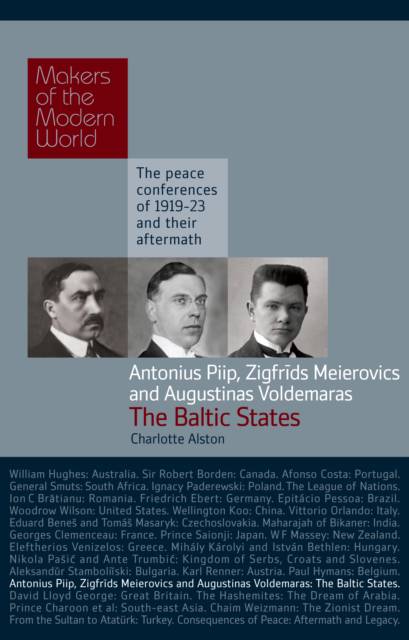
Piip, Meierovics & Voldemaras: The Baltic States
The Peace Conferences of 1919-23 and Their Aftermath
Charlotte Alston
€ 18,45
+ 36 punten
Omschrijving
Conflict on the borders of the Russian 'Empire', whatever the complexion of the government controlling it, has been a constant feature of the past 90 years, most recently with Russia's brief war with Georgia in August 2008. In 1919, as the smaller nations on Russia's borders sought self-determination while the Civil War raged between the Whites and the Bolsheviks, the Paris Peace Conference struggled with a situation complicated by mutually exclusive aims. The Baltic States of Latvia, Lithuania and Estonia were seen by both the Russians and the Western Allies as a protective buffer for their own territory, which led to the curious situation that the Peace Conference requested German troops to remain temporarily in the Baltic territory they had occupied during the First World War to block the westward spread of the Bolshevik Revolution. The ongoing civil war in Russia further complicated the issue, because if the Whites should win and restore the 'legitimate' Russian government, the Peace Conference could not divide up the territory of a power that had been one of the original members of the Entente. The US politician Herbert Hoover described Russia as 'Banquo's ghost' at the Paris Peace Conference, an invisible but influential presence, and nowhere can this be more clearly seen than in the deliberations over the Baltic States.
Specificaties
Betrokkenen
- Auteur(s):
- Uitgeverij:
Inhoud
- Aantal bladzijden:
- 224
- Taal:
- Engels
- Reeks:
Eigenschappen
- Productcode (EAN):
- 9781905791712
- Verschijningsdatum:
- 26/04/2011
- Uitvoering:
- Hardcover
- Formaat:
- Genaaid
- Afmetingen:
- 135 mm x 201 mm
- Gewicht:
- 417 g



Alleen bij Standaard Boekhandel
+ 36 punten op je klantenkaart van Standaard Boekhandel
Cadeau

AANGERADEN


Beoordelingen
We publiceren alleen reviews die voldoen aan de voorwaarden voor reviews. Bekijk onze voorwaarden voor reviews.