


- Afhalen na 1 uur in een winkel met voorraad
- Gratis thuislevering in België vanaf € 30
- Ruim aanbod met 7 miljoen producten
- Afhalen na 1 uur in een winkel met voorraad
- Gratis thuislevering in België vanaf € 30
- Ruim aanbod met 7 miljoen producten





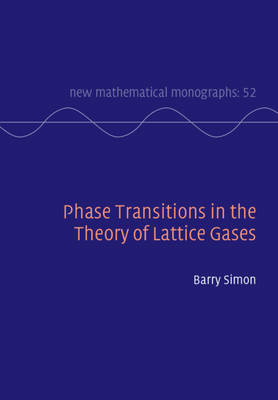
Phase Transitions in the Theory of Lattice Gases
Barry Simon
€ 180,45
+ 360 punten
Omschrijving
The intersection of statistical mechanics and mathematical analysis has proved a fertile ground for mathematical physics and probability, and in the decades since lattice gases were first proposed as a model for describing physical systems at the atomic level, our understanding of them has grown tremendously. A book that provides a comprehensive account of the methods used in the study of phase transitions for Ising models and classical and quantum Heisenberg models has been long overdue. This book, written by one of the masters of the subject, is just that. Topics covered include correlation inequalities, Lee-Yang theorems, the Peierls method, the Hohenberg-Mermin-Wagner method, infrared bounds, random cluster methods, random current methods and BKT transition. The final section outlines major open problems to inspire future work. This is a must-have reference for researchers in mathematical physics and probability and serves as an entry point, albeit advanced, for students entering this active area.
Specificaties
Betrokkenen
- Auteur(s):
- Uitgeverij:
Inhoud
- Aantal bladzijden:
- 644
- Taal:
- Engels
- Reeks:
- Reeksnummer:
- nr. 52
Eigenschappen
- Productcode (EAN):
- 9781108491853
- Verschijningsdatum:
- 13/11/2025
- Uitvoering:
- Hardcover
- Formaat:
- Genaaid
- Afmetingen:
- 178 mm x 254 mm
- Gewicht:
- 1324 g


Alleen bij Standaard Boekhandel
+ 360 punten op je klantenkaart van Standaard Boekhandel
Cadeau

AANGERADEN


Beoordelingen
We publiceren alleen reviews die voldoen aan de voorwaarden voor reviews. Bekijk onze voorwaarden voor reviews.