


- Afhalen na 1 uur in een winkel met voorraad
- Gratis thuislevering in België vanaf € 30
- Ruim aanbod met 7 miljoen producten
- Afhalen na 1 uur in een winkel met voorraad
- Gratis thuislevering in België vanaf € 30
- Ruim aanbod met 7 miljoen producten





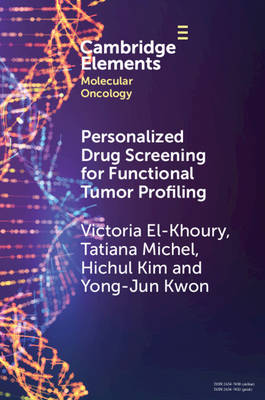
Personalized drug screening for functional tumor profiling
Victoria El-Khoury, Tatiana Michel, Hichul Kim
€ 33,45
+ 66 punten
Omschrijving
Despite considerable advances in our understanding of the biology that underlies tumor development and progression of cancer and the rapidly evolving field of personalized medicine, cancer is still one of the deadliest diseases. Many cancer patients have benefited from the survival improvements observed with targeted therapies but only a small subset of patients receiving targeted drugs experience an objective response. Because cancer is a complex and heterogeneous disease, the search for effective cancer treatments will need to address not only patient-specific molecular defects but also aspects of the tumor microenvironment. The functional tumor profiling directly measures the cellular phenotype, in particular tumor growth, in response to drugs using patient-derived tumor models and might be the next step toward precision oncology. In this Element, the authors discuss the personalized drug screening as a novel patient stratification strategy for the determination of individualized treatment choices in oncology.
Specificaties
Betrokkenen
- Auteur(s):
- Uitgeverij:
Inhoud
- Aantal bladzijden:
- 30
- Taal:
- Engels
- Reeks:
Eigenschappen
- Productcode (EAN):
- 9781009016933
- Verschijningsdatum:
- 7/07/2022
- Uitvoering:
- Paperback
- Formaat:
- Trade paperback (VS)
- Afmetingen:
- 152 mm x 229 mm
- Gewicht:
- 54 g


Alleen bij Standaard Boekhandel
+ 66 punten op je klantenkaart van Standaard Boekhandel
AANGERADEN


Beoordelingen
We publiceren alleen reviews die voldoen aan de voorwaarden voor reviews. Bekijk onze voorwaarden voor reviews.