


- Afhalen na 1 uur in een winkel met voorraad
- Gratis thuislevering in België vanaf € 30
- Ruim aanbod met 7 miljoen producten
- Afhalen na 1 uur in een winkel met voorraad
- Gratis thuislevering in België vanaf € 30
- Ruim aanbod met 7 miljoen producten





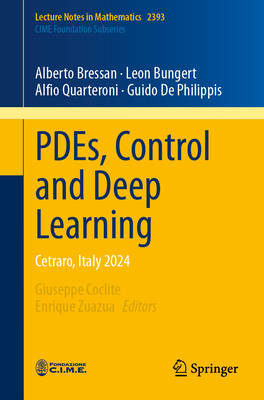
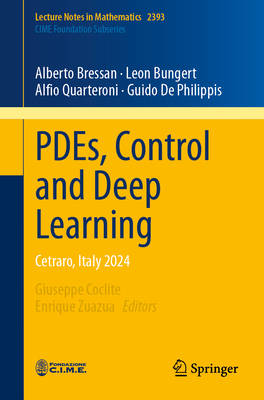
Pdes, Control and Deep Learning
Cetraro, Italy 2024
Alberto Bressan, Leon Bungert, Alfio Quarteroni, Guido de Philippis
€ 70,45
+ 140 punten
Eenvoudig bestellen
Veilig betalen


Gratis thuislevering vanaf € 30 (via bpost)
Gratis levering in je Standaard Boekhandel
Omschrijving
This volume includes lectures presented at the CIME School on "PDEs, Control and Deep Learning", held in Cetraro (Italy) from July 22 to 26, 2024. It provides a comprehensive and up-to-date view of the diverse and rapidly evolving field of nonlinear partial differential equations (PDEs), with an emphasis on modeling, analysis, control, and deep learning aspects. The theory of PDEs interacts closely with almost all areas of physics and many branches of mathematics. As explicit solutions of PDEs are rarely available (except in the simplest cases), numerical approximations play a central role in their study. Machine learning, particularly through artificial neural networks, introduces powerful methods for function approximation through layered structures of interconnected units (neurons) that combine linear transformations and nonlinear activations. Deep learning (the use of neural networks with many hidden layers) has proven to be remarkably effective in a wide range of applications. At the same time, recent advances in PDEs and control theory are beginning to inform machine learning, providing new theoretical perspectives. The book will be a valuable resource for PhD students and researchers seeking to deepen their understanding of partial differential equations, control, and their connections to modern machine learning.
Specificaties
Betrokkenen
- Auteur(s):
- Uitgeverij:
Inhoud
- Aantal bladzijden:
- 112
- Taal:
- Engels
- Reeks:
- Reeksnummer:
- nr. 2393
Eigenschappen
- Productcode (EAN):
- 9783032187420
- Verschijningsdatum:
- 6/09/2026
- Uitvoering:
- Paperback
- Formaat:
- Trade paperback (VS)
- Afmetingen:
- 155 mm x 235 mm


Alleen bij Standaard Boekhandel
+ 140 punten op je klantenkaart van Standaard Boekhandel
CADEAU

AANGERADEN


Beoordelingen
We publiceren alleen reviews die voldoen aan de voorwaarden voor reviews. Bekijk onze voorwaarden voor reviews.