



Je cadeautjes zeker op tijd in huis hebben voor de feestdagen? Kom langs in onze winkels en vind het perfecte geschenk!
- Afhalen na 1 uur in een winkel met voorraad
- Gratis thuislevering in België vanaf € 30
- Ruim aanbod met 7 miljoen producten
Je cadeautjes zeker op tijd in huis hebben voor de feestdagen? Kom langs in onze winkels en vind het perfecte geschenk!
- Afhalen na 1 uur in een winkel met voorraad
- Gratis thuislevering in België vanaf € 30
- Ruim aanbod met 7 miljoen producten





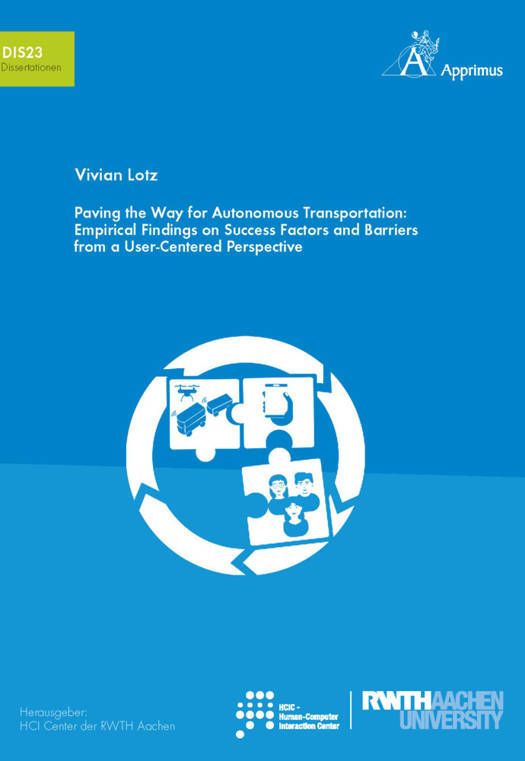
Paving the Way for Autonomous Transportation: Empirical Findings on Success Factors and Barriers from a User-Centered Perspective
DE
Vivian Lotz
€ 53,45
+ 106 punten
Omschrijving
Mobility and ensuring it are essential in our globalized world. In this context, automation promises a mobility future that is safer, more efficient, and sustainable - but only if it meets real human needs. This thesis offers a human-centered take on the challenge of how to design automated transport solutions. It offers insights grounded in user-centered design and technology acceptance research. Via an empirical mixed methods approach, it holistically maps out barriers and success factors for introducing automation into our transport systems via two thematic deep dives. Firstly, the criteria and influencing factors for successful human-technology interaction are identified. Results show that, apart from system characteristics such as performance, social endorsement plays a crucial role in forming adoption intentions. Nonetheless, one of the biggest obstacles lies in the associated traffic safety risks or, more specifically, in people's remaining uncertainty about system reliability, system limits, user responsibilities, and regulations. Secondly, a comparative analysis of user requirements and acceptance drivers across different transport modes reveals that while acceptance factors are similar, with safety being at the forefront, their relative importance varies across modes. In the case of urban air mobility, aspects such as safety, environmental impact, and time savings are perceived as even more important than in road-based transport. Ultimately, this thesis underscores the need to design automated mobility solutions with users, not just for them. Following this thought, the results provide an empirical foundation for actionable recommendations for the design of autonomous mobility systems, service design, and communication needs based on identified information deficits.
Specificaties
Betrokkenen
- Auteur(s):
- Uitgeverij:
Inhoud
- Aantal bladzijden:
- 250
- Taal:
- Engels
- Reeks:
- Reeksnummer:
- nr. 23
Eigenschappen
- Productcode (EAN):
- 9783985552894
- Uitvoering:
- Paperback
- Afmetingen:
- 148 mm x 13 mm
- Gewicht:
- 331 g


Alleen bij Standaard Boekhandel
+ 106 punten op je klantenkaart van Standaard Boekhandel
CADEAU


Beoordelingen
We publiceren alleen reviews die voldoen aan de voorwaarden voor reviews. Bekijk onze voorwaarden voor reviews.