


- Afhalen na 1 uur in een winkel met voorraad
- Gratis thuislevering in België vanaf € 30
- Ruim aanbod met 7 miljoen producten
- Afhalen na 1 uur in een winkel met voorraad
- Gratis thuislevering in België vanaf € 30
- Ruim aanbod met 7 miljoen producten





Omschrijving
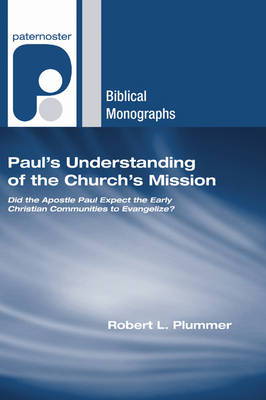
Did Paul expect his churches to engage in evangelistic activity which mirrored his own? Or have modern readers of the Bible wrongly projected Paul's apostolic passion upon the communities that he founded? Such is the charge of several recent authors, and if their thesis is correct nothing could have larger implications for how the modern church engages in mission. In this book, Robert L. Plummer engages in a careful study of Paul's letters to determine if the apostle expected the communities to which he wrote to engage in outward-directed missionary activity. Plummer helpfully summarizes the discussion to date on the debated issue, judiciously handles contested texts, and provides a way forward in addressing this critical question. While admitting that Paul rarely explicitly commands the communities he founded to evangelize, Plummer amasses significant incidental data to provide a convincing case that Paul did indeed expect his churches to engage in outward-directed missionary activity. Throughout the study, Plummer progressively builds a theological basis for the church's mission that is both compelling and distinctively Pauline.
Specificaties
Betrokkenen
- Auteur(s):
- Uitgeverij:
Inhoud
- Aantal bladzijden:
- 228
- Taal:
- Engels
- Reeks:
Eigenschappen
- Productcode (EAN):
- 9781597527231
- Verschijningsdatum:
- 1/06/2006
- Uitvoering:
- Paperback
- Formaat:
- Trade paperback (VS)
- Afmetingen:
- 154 mm x 228 mm
- Gewicht:
- 326 g


Alleen bij Standaard Boekhandel
+ 83 punten op je klantenkaart van Standaard Boekhandel
Cadeau

AANGERADEN


Beoordelingen
We publiceren alleen reviews die voldoen aan de voorwaarden voor reviews. Bekijk onze voorwaarden voor reviews.