


- Afhalen na 1 uur in een winkel met voorraad
- Gratis thuislevering in België vanaf € 30
- Ruim aanbod met 7 miljoen producten
- Afhalen na 1 uur in een winkel met voorraad
- Gratis thuislevering in België vanaf € 30
- Ruim aanbod met 7 miljoen producten





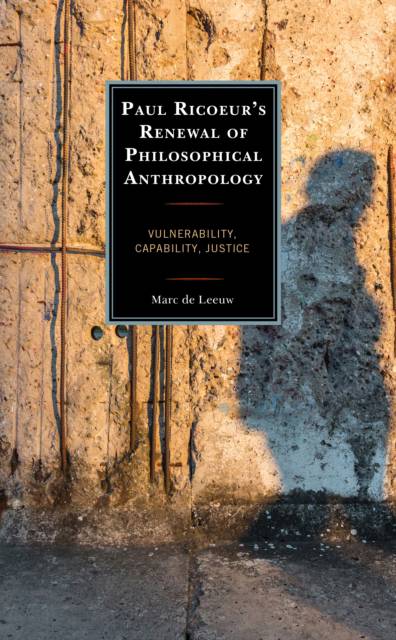
Paul Ricoeur's Renewal of Philosophical Anthropology
Vulnerability, Capability, Justice
Marc de Leeuw
€ 186,95
+ 373 punten
Eenvoudig bestellen
Veilig betalen


Gratis thuislevering vanaf € 30 (via bpost)
Gratis levering in je Standaard Boekhandel
Omschrijving
In Paul Ricoeur's Renewal of Philosophical Anthropology: Vulnerability, Capability, Justice, Marc de Leeuw argues that Ricoeur's philosophical project integrates the anthropological tradition while renewing its importance as a hermeneutic anthropology of human capability. Ricoeur posits that our cogito is neither its own absolute master, nor fully transparent to itself, inflicting a "wound" (brisé) and fracturing the center of Cartesian self-certainty. But the Nietzschean disillusionment that ensues does not simply amount to a victorious anti-cogito; it opens another path towards self-understanding. In place of the direct route of intuition is found a more complex way forward, one guided by interpretation. The task of philosophical anthropology is to understand the human through its interpretative, critical, and imaginative ability as well as its capacity to act towards, with, and for others; the interpretation of the world in front of us, the interpretation of "who we are," and the interpretation of what it means to be among others (as "other selves") coalesces in an anthropology that binds the question of the self to a moral, ethical, and political project, one aiming to reflect our existence-in-common. For Ricoeur, the basic question of our subjective and normative "standing" demands a fundamental response--a response toward our own otherness and to responsibilities triggered by the appeal of Others. In both cases, our vulnerability is inescapable: we can never have an absolute self-knowledge nor an absolute knowledge of Others. Ricoeur turns this fundamental aporia into an affirmative philosophical anthropology of human action, attestation, and justice.
Specificaties
Betrokkenen
- Auteur(s):
- Uitgeverij:
Inhoud
- Aantal bladzijden:
- 216
- Taal:
- Engels
- Reeks:
Eigenschappen
- Productcode (EAN):
- 9781498595582
- Verschijningsdatum:
- 27/12/2021
- Uitvoering:
- Hardcover
- Formaat:
- Genaaid
- Afmetingen:
- 152 mm x 229 mm
- Gewicht:
- 489 g


Alleen bij Standaard Boekhandel
+ 373 punten op je klantenkaart van Standaard Boekhandel
CADEAU

AANGERADEN


Beoordelingen
We publiceren alleen reviews die voldoen aan de voorwaarden voor reviews. Bekijk onze voorwaarden voor reviews.