


- Afhalen na 1 uur in een winkel met voorraad
- Gratis thuislevering in België vanaf € 30
- Ruim aanbod met 7 miljoen producten
- Afhalen na 1 uur in een winkel met voorraad
- Gratis thuislevering in België vanaf € 30
- Ruim aanbod met 7 miljoen producten





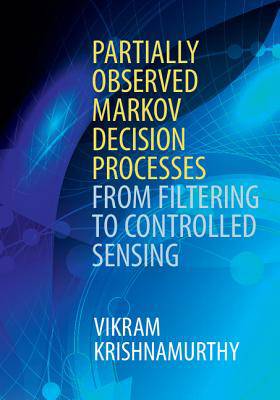
Partially Observed Markov Decision Processes
From Filtering to Controlled Sensing
Vikram Krishnamurthy
Hardcover | Engels
€ 116,45
+ 232 punten
Omschrijving
Covering formulation, algorithms, and structural results, and linking theory to real-world applications in controlled sensing (including social learning, adaptive radars and sequential detection), this book focuses on the conceptual foundations of partially observed Markov decision processes (POMDPs). It emphasizes structural results in stochastic dynamic programming, enabling graduate students and researchers in engineering, operations research, and economics to understand the underlying unifying themes without getting weighed down by mathematical technicalities. Bringing together research from across the literature, the book provides an introduction to nonlinear filtering followed by a systematic development of stochastic dynamic programming, lattice programming and reinforcement learning for POMDPs. Questions addressed in the book include: when does a POMDP have a threshold optimal policy? When are myopic policies optimal? How do local and global decision makers interact in adaptive decision making in multi-agent social learning where there is herding and data incest? And how can sophisticated radars and sensors adapt their sensing in real time?
Specificaties
Betrokkenen
- Auteur(s):
- Uitgeverij:
Inhoud
- Aantal bladzijden:
- 488
- Taal:
- Engels
Eigenschappen
- Productcode (EAN):
- 9781107134607
- Verschijningsdatum:
- 21/03/2016
- Uitvoering:
- Hardcover
- Formaat:
- Genaaid
- Afmetingen:
- 175 mm x 257 mm
- Gewicht:
- 1147 g


Alleen bij Standaard Boekhandel
+ 232 punten op je klantenkaart van Standaard Boekhandel
Cadeau

AANGERADEN


Beoordelingen
We publiceren alleen reviews die voldoen aan de voorwaarden voor reviews. Bekijk onze voorwaarden voor reviews.