



Bedankt voor het vertrouwen het afgelopen jaar! Om jou te bedanken bieden we GRATIS verzending (in België) aan op alles gedurende de hele maand januari.
- Afhalen na 1 uur in een winkel met voorraad
- In januari gratis thuislevering in België
- Ruim aanbod met 7 miljoen producten
Bedankt voor het vertrouwen het afgelopen jaar! Om jou te bedanken bieden we GRATIS verzending (in België) aan op alles gedurende de hele maand januari.
- Afhalen na 1 uur in een winkel met voorraad
- In januari gratis thuislevering in België
- Ruim aanbod met 7 miljoen producten





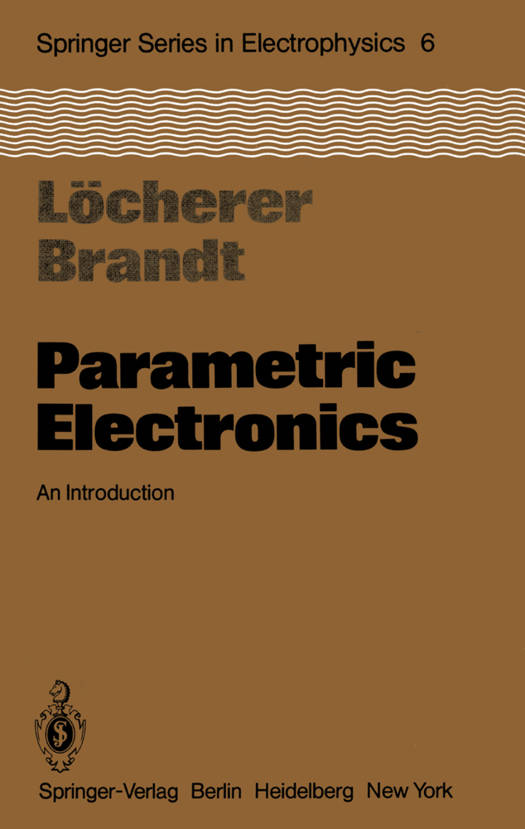
Omschrijving
In this chapter, first the parametric principle is illustrated by two simple examples, one mechanical and one electrical. Then the realization of time- varying reactances is explained, followed by a short history of "parametric electronics". This survey demonstrates the importance of parametric circuits in the field of low-noise microwave electronics as well as explains the organization of this book. 1.1 The Parametric Principle An oscillating system comprising a single or several time-varying energy- storing elements is called a parametric system; usually the variations are harmonic functions of time. Everybody knows one example of a mechanical parametric system from his childhood, namely, a swing. Therefore, we will start with this example though as it turns out, a swing is a rather compli- cated parametric system. Fortunately, the electrical parametric systems, which form the object of this book, are simpler. Figure 1.1 shows such a swing. If it is removed from its equilibrium position and the child stands on it in a fixed attitude, the swing oscillates with a certain amplitude, the magnitude of which decreases with time due to the mechanical friction of the system. To increase the amplitude of oscil- lation, the child changes positions during swinging: it crouches and straightens in a certain way twice during one cycle of the swing.
Specificaties
Betrokkenen
- Auteur(s):
- Uitgeverij:
Inhoud
- Aantal bladzijden:
- 330
- Taal:
- Engels
- Reeks:
- Reeksnummer:
- nr. 6
Eigenschappen
- Productcode (EAN):
- 9783642679391
- Verschijningsdatum:
- 10/12/2011
- Uitvoering:
- Paperback
- Formaat:
- Trade paperback (VS)
- Afmetingen:
- 152 mm x 229 mm
- Gewicht:
- 467 g


Alleen bij Standaard Boekhandel
+ 311 punten op je klantenkaart van Standaard Boekhandel
SOLDEN


Beoordelingen
We publiceren alleen reviews die voldoen aan de voorwaarden voor reviews. Bekijk onze voorwaarden voor reviews.