


- Afhalen na 1 uur in een winkel met voorraad
- Gratis thuislevering in België vanaf € 30
- Ruim aanbod met 7 miljoen producten
- Afhalen na 1 uur in een winkel met voorraad
- Gratis thuislevering in België vanaf € 30
- Ruim aanbod met 7 miljoen producten





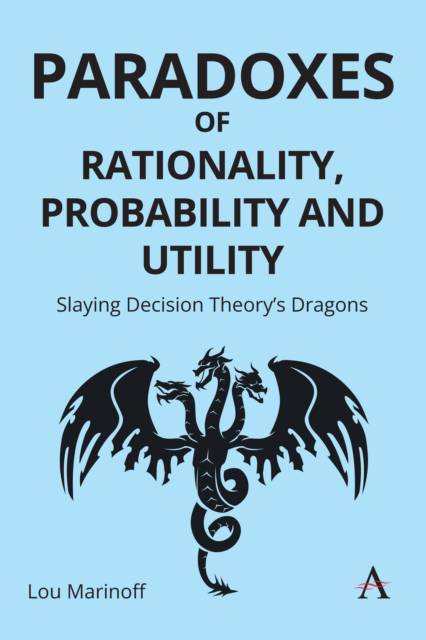
Paradoxes of Rationality, Probability, and Utility
Slaying Decision Theory's Dragons
Lou Marinoff
Hardcover | Engels
€ 177,45
+ 354 punten
Omschrijving
An anthology that presents 25 years of Lou Marinoff's work addressing foundational paradoxes and dilemmas in rational choice, probability, and utility theory, offering original analyses of and/or resolutions to classic problems like the Prisoner's Dilemma, Newcomb's Problem, and the Two Envelopes Problem
This unique anthology reflects the author's resolutions of some of the most perplexing, interesting, and widely discussed problems arising in rational choice theory, probability theory, and utility theory. It spans 25 years of his research and publications in these related fields. Part One treats the Prisoner's Dilemma (PD). It disproves Axelrod's and Hamilton's landmark but mistaken claim (Science, 1981) that Rapoport's legendary Tit-for-Tat is an evolutionarily stable strategy and introduces a family of optimal strategies for iterated computer tournaments. Their members maximize expected utilities, embodying the properties of provocability, forgiveness, and exploitiveness. The leading member outperforms Tit-for-Tat. However, members of this family surprisingly fail to perform well against their own twins and siblings, thus reinforcing Axelrod's lemma that there is no "best" strategy for iterated PDs independent of the competing population.
Part Two decouples Newcomb's problem from Braess's paradox, the Cohen-Kelly queuing paradox, and the PD, thus illustrating (contra Irvine, 1993) that Braess's paradox does not resolve Newcomb's problem. It then describes an innovative experiment with rationality in cyberspace, analogous to Hardin's Tragedy of the Commons. The experiment shows that ostensibly "rational" actors consistently make irrational choices, even (and sometimes especially) when their irrationality is revealed to them. Part Two concludes with a computer model that reveals why some players always defect in non-cooperative games, holding implications for social and political stability. The model shows that even an initial majority of 67% cooperators can degenerate into a 100% non-cooperative population, while higher initial percentages of cooperators can maintain majority cooperation yet must still endure "resistant" nuclei of permanently defecting players.
Part Three presents a (1994) resolution of Bertrand's random chord paradox, which still stands among the most convincing treatments since the problem was originally posed in 1889. A recent noteworthy challenge (Shackel, 2024) is summarized with a response. Part Three then dissects divergent solutions by Elga and Lewis to the perplexing Sleeping Beauty problem, presenting new arguments against Elga's solution that decide the issue in favor of Lewis. Part Three ends by decisively resolving the notorious Two Envelopes paradox--still hotly debated after more than 30 years--by exposing a fundamental and fatal mis-application of the Principle of Indifference.
Part Four takes up a moral question debated by Hobbes, Spinoza, and Kant--"Should one lie to a highway robber to gain one's release?"--and in so doing exposes a fissure in Gauthier's otherwise well-received ethics of constrained maximization. It then develops a holistic interpretation of meaning, using a reverse Turing test to rebut if not disprove the Strong AI thesis. The central question is not how well Turing machines can simulate human intelligence; rather, how badly humans can fail to simulate machine intelligence. Finally, Part Four explores amusingly counter-intuitive ontological implications of an old Cambridge challenge puzzle--The Coconut Problem--including an ingenious but "impossible" negative solution by quantum physicist Paul Dirac.
Specificaties
Betrokkenen
- Auteur(s):
- Uitgeverij:
Inhoud
- Aantal bladzijden:
- 300
- Taal:
- Engels
Eigenschappen
- Productcode (EAN):
- 9781839998690
- Verschijningsdatum:
- 5/05/2026
- Uitvoering:
- Hardcover
- Formaat:
- Genaaid
- Afmetingen:
- 152 mm x 229 mm
- Gewicht:
- 571 g



Alleen bij Standaard Boekhandel
+ 354 punten op je klantenkaart van Standaard Boekhandel
Cadeau

AANGERADEN


Beoordelingen
We publiceren alleen reviews die voldoen aan de voorwaarden voor reviews. Bekijk onze voorwaarden voor reviews.