


- Afhalen na 1 uur in een winkel met voorraad
- Gratis thuislevering in België vanaf € 30
- Ruim aanbod met 7 miljoen producten
- Afhalen na 1 uur in een winkel met voorraad
- Gratis thuislevering in België vanaf € 30
- Ruim aanbod met 7 miljoen producten




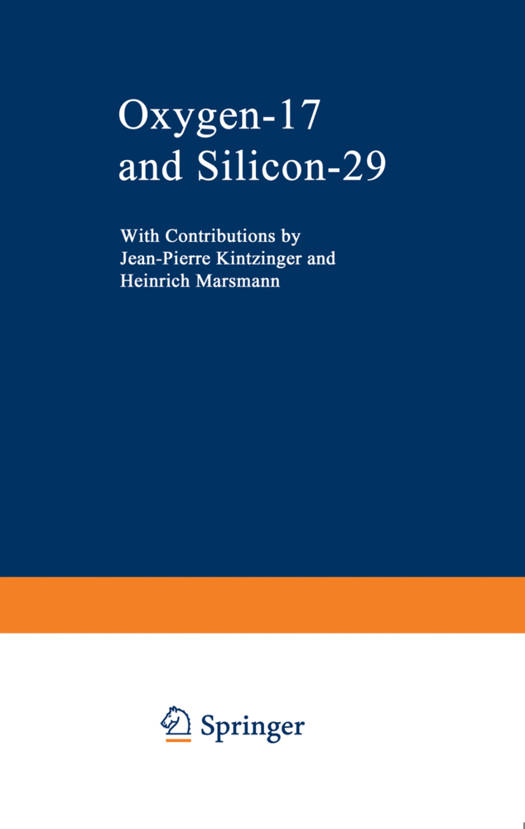
Oxygen-17 and Silicon-29
€ 259,45
+ 518 punten
Omschrijving
Although it was shown very early [1] that the isotope 29Si is very valuable for NMR research, severe technical difficulties had to be overcome before silicon spectra could be recorded. This was due to the low sensitivity of the isotope resulting from its low gyro magnetic ratio, its low abundance and the rather long relaxation times. The introduction of the Fourier-Transform-Technique (FT-NMR) helped to surmount most of these problems, with the result, that more and more papers concerning silicon NMR appear. Thus, it seems now that most of the salient features of 29Si-NMR are known today. Some resume of the state of the art of 29Si_NMR have been reported [1-4]. Although the theory of 29Si-NMR is not yet understood beyond the basic features, it promises to be of value mainly for two reasons: 1. Silicon is strategically located in the Periodic Table of the elements between the elements carbon, aluminum and phosphorus. For an unified theory of chemical shifts and coupling constants of the heavier elements silicon NMR values will be important. 2. The normal coordination number of silicon is four. If the current view of the chemical shifts of the heavier elements is correct, then the paramagnetic part is dominant for the measured shift data. Two of the parameters used for the calcu- lation of the paramagnetic part are bond orders and angles. Bond angles are rare- ly determined experimentally with high precision.
Specificaties
Betrokkenen
- Uitgeverij:
Inhoud
- Aantal bladzijden:
- 238
- Taal:
- Engels
- Reeks:
- Reeksnummer:
- nr. 17
Eigenschappen
- Productcode (EAN):
- 9783642877643
- Verschijningsdatum:
- 23/08/2014
- Uitvoering:
- Paperback
- Formaat:
- Trade paperback (VS)
- Afmetingen:
- 210 mm x 297 mm
- Gewicht:
- 603 g

Alleen bij Standaard Boekhandel
+ 518 punten op je klantenkaart van Standaard Boekhandel
Wedstrijd


Beoordelingen
We publiceren alleen reviews die voldoen aan de voorwaarden voor reviews. Bekijk onze voorwaarden voor reviews.