


- Afhalen na 1 uur in een winkel met voorraad
- Gratis thuislevering in België vanaf € 30
- Ruim aanbod met 7 miljoen producten
- Afhalen na 1 uur in een winkel met voorraad
- Gratis thuislevering in België vanaf € 30
- Ruim aanbod met 7 miljoen producten





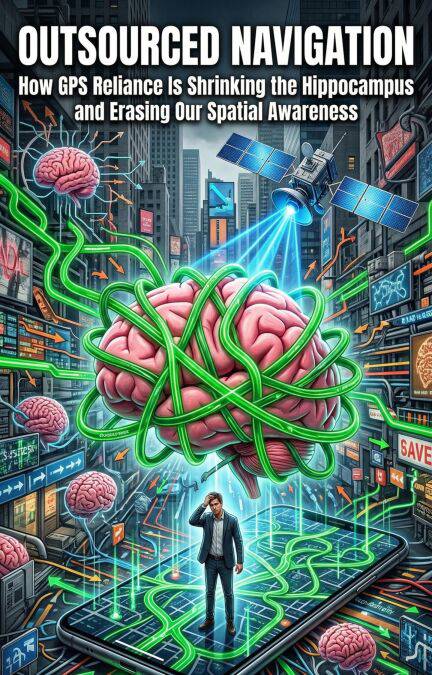
Outsourced Navigation E-BOOK
How GPS Reliance Is Shrinking the Hippocampus and Erasing Our Spatial Awareness
Laura Mitchell
E-book | Engels
€ 4,99
Omschrijving
Before the invention of smartphones, navigating a new city required building a mental map. We looked for landmarks, estimated distances, and actively engaged with our physical environment. Today, we simply stare at a glowing blue line on a screen and follow auditory commands. We arrive at our destination, but we have absolutely no idea how we got there.
This reliance on GPS is a prime example of "cognitive offloading"—outsourcing our mental processing to an external device. While incredibly convenient, neuroscientists are discovering a terrifying side effect: by never exercising our spatial memory, we are physically altering our brains. Studies on London taxi drivers prove that active navigation enlarges the hippocampus. Conversely, chronic reliance on turn-by-turn GPS actually causes this crucial area of the brain—which is also responsible for long-term memory formation—to shrink and atrophy.
This alarming neurological exploration reveals the hidden biological cost of convenience. It examines how losing our innate sense of direction alters our relationship with the physical world, diminishes our observational skills, and may even accelerate cognitive decline in later life.
Stop letting a satellite do your thinking. Learn how to break your dependency on turn-by-turn directions, practice intentional wayfinding, and rebuild the neurological pathways of your internal compass before they disappear completely.
This reliance on GPS is a prime example of "cognitive offloading"—outsourcing our mental processing to an external device. While incredibly convenient, neuroscientists are discovering a terrifying side effect: by never exercising our spatial memory, we are physically altering our brains. Studies on London taxi drivers prove that active navigation enlarges the hippocampus. Conversely, chronic reliance on turn-by-turn GPS actually causes this crucial area of the brain—which is also responsible for long-term memory formation—to shrink and atrophy.
This alarming neurological exploration reveals the hidden biological cost of convenience. It examines how losing our innate sense of direction alters our relationship with the physical world, diminishes our observational skills, and may even accelerate cognitive decline in later life.
Stop letting a satellite do your thinking. Learn how to break your dependency on turn-by-turn directions, practice intentional wayfinding, and rebuild the neurological pathways of your internal compass before they disappear completely.
Specificaties
Betrokkenen
- Auteur(s):
- Uitgeverij:
Inhoud
- Aantal bladzijden:
- 191
- Taal:
- Engels
Eigenschappen
- Productcode (EAN):
- 9783565300334
- Verschijningsdatum:
- 6/03/2026
- Uitvoering:
- E-book
- Formaat:
- ePub


Alleen bij Standaard Boekhandel
Cadeau

AANGERADEN


Beoordelingen
We publiceren alleen reviews die voldoen aan de voorwaarden voor reviews. Bekijk onze voorwaarden voor reviews.