



Bedankt voor het vertrouwen het afgelopen jaar! Om jou te bedanken bieden we GRATIS verzending (in België) aan op alles gedurende de hele maand januari.
- Afhalen na 1 uur in een winkel met voorraad
- In januari gratis thuislevering in België
- Ruim aanbod met 7 miljoen producten
Bedankt voor het vertrouwen het afgelopen jaar! Om jou te bedanken bieden we GRATIS verzending (in België) aan op alles gedurende de hele maand januari.
- Afhalen na 1 uur in een winkel met voorraad
- In januari gratis thuislevering in België
- Ruim aanbod met 7 miljoen producten





Omschrijving
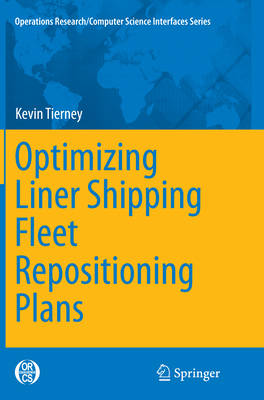
This monograph addresses several critical problems to the operations of shipping lines and ports, and provides algorithms and mathematical models for use by shipping lines and port authorities for decision support. One of these problems is the repositioning of container ships in a liner shipping network in order to adjust the network to seasonal shifts in demand or changes in the world economy. We provide the first problem description and mathematical model of repositioning and define the liner shipping fleet repositioning problem (LSFRP). The LSFRP is characterized by chains of interacting activities with a multi-commodity flow over paths defined by the activities chosen. We first model the problem without cargo flows with a variety of well-known optimization techniques, as well as using a novel method called linear temporal optimization planning that combines linear programming with partial-order planning in a branch-and-bound framework. We then model the LSFRP with cargo flows, using several different mathematical models as well as two heuristic approaches. We evaluate our techniques on a real-world dataset that includes a scenario from our industrial collaborator. We show that our approaches scale to the size of problems faced by industry, and are also able to improve the profit on the reference scenario by over US$14 million.
Specificaties
Betrokkenen
- Auteur(s):
- Uitgeverij:
Inhoud
- Aantal bladzijden:
- 182
- Taal:
- Engels
- Reeks:
- Reeksnummer:
- nr. 57
Eigenschappen
- Productcode (EAN):
- 9783319368412
- Verschijningsdatum:
- 15/10/2016
- Uitvoering:
- Paperback
- Afmetingen:
- 156 mm x 236 mm
- Gewicht:
- 335 g


Alleen bij Standaard Boekhandel
+ 201 punten op je klantenkaart van Standaard Boekhandel
SOLDEN


Beoordelingen
We publiceren alleen reviews die voldoen aan de voorwaarden voor reviews. Bekijk onze voorwaarden voor reviews.