


- Afhalen na 1 uur in een winkel met voorraad
- Gratis thuislevering in België vanaf € 30
- Ruim aanbod met 7 miljoen producten
- Afhalen na 1 uur in een winkel met voorraad
- Gratis thuislevering in België vanaf € 30
- Ruim aanbod met 7 miljoen producten





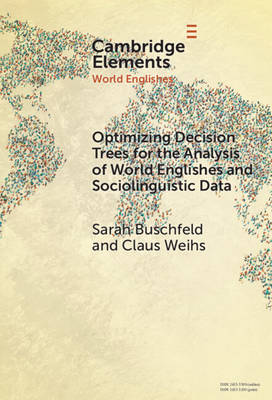
Optimizing Decision Trees for the Analysis of World Englishes and Sociolinguistic Data
Sarah Buschfeld, Claus Weihs
€ 124,45
+ 248 punten
Uitvoering
Omschrijving
This Element introduces PrInDT (Prediction and Interpretation in Decision Trees), a statistical approach for modeling relationships between extra- and intralinguistic variables in World Englishes. It is based on decision trees and controls their size in a way that they are easy and straightforward to interpret. Furthermore, PrInDT optimizes their accuracy so that they best fit the data and can be reliably used for prediction. Moreover, it can handle unbalanced classes that occur, for example, when comparing non-standard with standard linguistic realizations. The various PrInDT functions can deal with classification and regression tasks and can analyze multiple endogenous variables jointly, even for models combining classification and regression. The authors introduce these features in some detail and apply them to World Englishes and sociolinguistic datasets. As examples, they draw on L1 child data from England and Singapore as well as linguistic landscapes data from the Eastern Caribbean island of St. Martin.
Specificaties
Betrokkenen
- Auteur(s):
- Uitgeverij:
Inhoud
- Aantal bladzijden:
- 108
- Taal:
- Engels
- Reeks:
Eigenschappen
- Productcode (EAN):
- 9781009470315
- Verschijningsdatum:
- 23/04/2026
- Uitvoering:
- Hardcover
- Formaat:
- Genaaid
- Afmetingen:
- 152 mm x 229 mm
- Gewicht:
- 317 g


Alleen bij Standaard Boekhandel
+ 248 punten op je klantenkaart van Standaard Boekhandel
Cadeau

AANGERADEN


Beoordelingen
We publiceren alleen reviews die voldoen aan de voorwaarden voor reviews. Bekijk onze voorwaarden voor reviews.