


- Afhalen na 1 uur in een winkel met voorraad
- Gratis thuislevering in België vanaf € 30
- Ruim aanbod met 7 miljoen producten
- Afhalen na 1 uur in een winkel met voorraad
- Gratis thuislevering in België vanaf € 30
- Ruim aanbod met 7 miljoen producten





€ 349,45
+ 698 punten
Uitvoering
Omschrijving
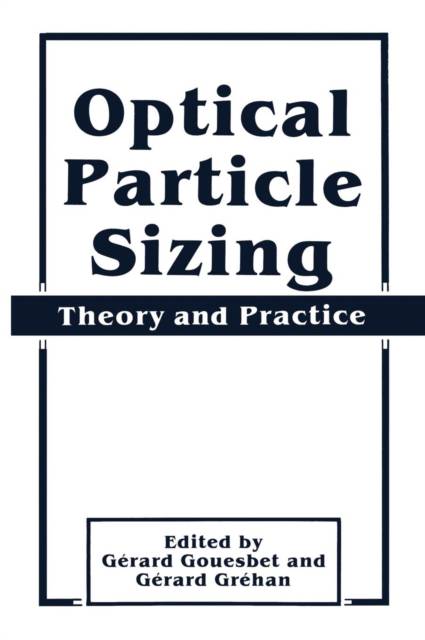
Optical particle s1z1ng is undoubtedly a fascinating field of research of the utmost practical importance. In the Universe fluids are nearly everywhere, and when they occur they almost invariably contain particles. Inside our bodies we can take the example of blood transporting a vi tal procession of red and white cells. Around us, we can find various particles in the air we breathe, bubbles in the champagne or the soda we drink, or natural and artificial (polluting!) particles in the lakes we swim in. Industrial processes and systems are also concerned with particles, from pulverized coal flames to fluidized beds, in a range of applications involving rocket exhausts, pneuma tic transport and more generally the infinite realm of mul tiphase situations. Such an obviously vast field would require a whole volume like this one merely to attempt to describe it superficially. To be sure, we would need a scientific Prevert to catalogue such an endless inventory. Finally, even outside our terrestrial spaceship particles can be detected in alien atmospheres or between stars. Theorists will enjoy analyzing the richness of light/particle interact. ion, a subject which is very far from being exhausted. Experimental researchers will love designing and studying various probing instruments with a laser source at the input and a computer at the output, two requisites of today' s technological revolution.
Specificaties
Betrokkenen
- Auteur(s):
- Uitgeverij:
Inhoud
- Aantal bladzijden:
- 642
- Taal:
- Engels
Eigenschappen
- Productcode (EAN):
- 9780306427817
- Verschijningsdatum:
- 1/05/1988
- Uitvoering:
- Hardcover
- Formaat:
- Genaaid
- Afmetingen:
- 178 mm x 254 mm
- Gewicht:
- 1351 g



Alleen bij Standaard Boekhandel
+ 698 punten op je klantenkaart van Standaard Boekhandel
Cadeau

AANGERADEN


Beoordelingen
We publiceren alleen reviews die voldoen aan de voorwaarden voor reviews. Bekijk onze voorwaarden voor reviews.