



Je cadeautjes zeker op tijd in huis hebben voor de feestdagen? Kom langs in onze winkels en vind het perfecte geschenk!
- Afhalen na 1 uur in een winkel met voorraad
- Gratis thuislevering in België vanaf € 30
- Ruim aanbod met 7 miljoen producten
Je cadeautjes zeker op tijd in huis hebben voor de feestdagen? Kom langs in onze winkels en vind het perfecte geschenk!
- Afhalen na 1 uur in een winkel met voorraad
- Gratis thuislevering in België vanaf € 30
- Ruim aanbod met 7 miljoen producten





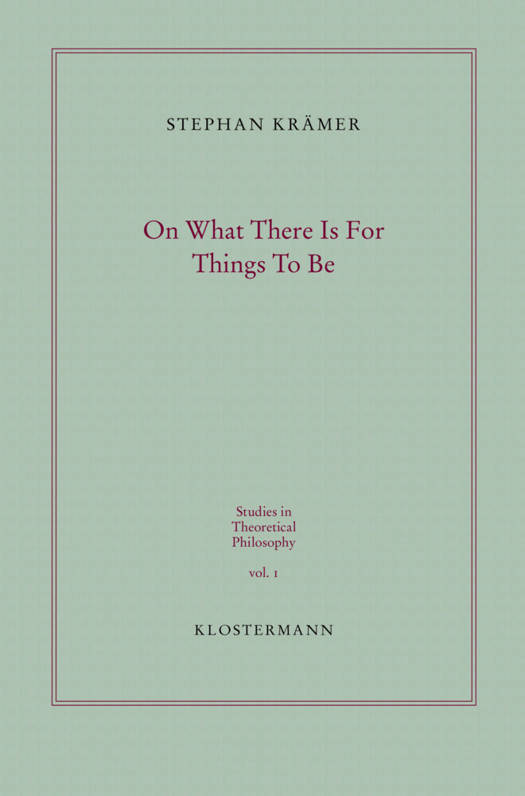
On What There Is For Things To Be
Ontological Commitment and Second-Order Quantification
Stephan Krämer
€ 33,95
+ 67 punten
Omschrijving
If Art is smart and Art is rich, then someone is both smart and rich - namely, Art. And if Art is smart and Bart is smart, then Art is something that Bart is, too - namely, smart. The first claim involves first-order quantification, a generalization concerning what kinds of things there are. The second involves second-order quantification, a generalization concerning what there is for things to be. Or so it appears. Following W.V.O. Quine, many philosophers have endorsed a thesis of Ontological Collapse about second-order quantification. They maintain that ultimately, second-order quantification reduces to first-order quantification over sets or properties, and therefore also carries the latter's distinctive ontological commitments.In this revised version of his doctoral dissertation, awarded the Wolfgang-Stegmüller-Prize in 2012, Stephan Krämer examines the major arguments for Ontological Collapse in detail and finds all of them wanting. Quantifications, he argues, fall into at least two irreducible kinds: those on what things there are, and those on what there is for things to be.
Specificaties
Betrokkenen
- Auteur(s):
- Uitgeverij:
Inhoud
- Aantal bladzijden:
- 260
- Taal:
- Engels
- Reeks:
- Reeksnummer:
- nr. 1
Eigenschappen
- Productcode (EAN):
- 9783465038689
- Uitvoering:
- Paperback
- Afmetingen:
- 155 mm x 235 mm
- Gewicht:
- 396 g


Alleen bij Standaard Boekhandel
+ 67 punten op je klantenkaart van Standaard Boekhandel
CADEAU


Beoordelingen
We publiceren alleen reviews die voldoen aan de voorwaarden voor reviews. Bekijk onze voorwaarden voor reviews.