


- Afhalen na 1 uur in een winkel met voorraad
- Gratis thuislevering in België vanaf € 30
- Ruim aanbod met 7 miljoen producten
- Afhalen na 1 uur in een winkel met voorraad
- Gratis thuislevering in België vanaf € 30
- Ruim aanbod met 7 miljoen producten





€ 51,95
+ 103 punten
Omschrijving
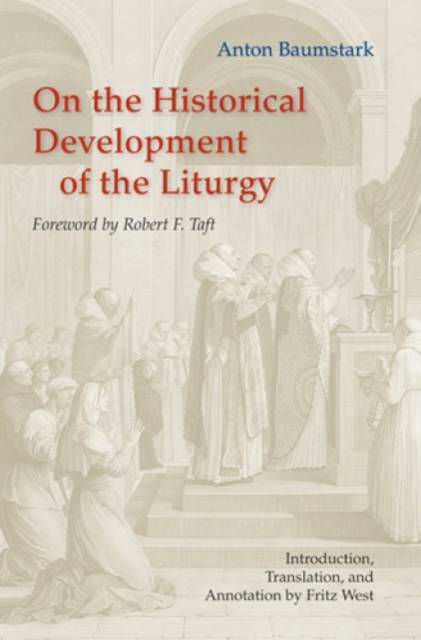
Anton Baumstark's On the Historical Development of the Liturgy (1923) complements his classic work, Comparative Liturgy. Together they lay out his liturgical methodology. Comparative Liturgy presents his method; On the Historical Development of the Liturgy offers his model.
This book was written for one audience and valued by another. Written to lead adherents of the nascent German liturgical movement to a deeper religious appreciation of Catholic worship, its methodology and scope have won the appreciation of liturgical specialists for nearly a century. In describing the organic growth of the liturgy, its shaping and distortion, Baumstark's reach extends from India to Ireland, Moscow to Axum, Carthage to Xi 'an. He discusses the influences of language, literature, doctrine, piety, politics, and culture. While his audacity can be breathtaking and his hypotheses grandiose, his approach is nevertheless stimulating. In this annotated edition, Fritz West provides the first English translation of this work by Anton Baumstark.
Trained in classical and oriental philology, Anton Baumstark (1872-1948) was prodigious as a scholar studying the literature, art, and liturgy of the whole church 'Oriental, Eastern, and Western. Comparative liturgy, his method for studying the historical development of the liturgy as an organism, has had a lasting influence, notably on the liturgical study of the Christian East. Fritz West, aliturgical scholar ordained in the United Church of Christ, has written numerous articles on liturgical methodology, the three-year lectionary, and worship in his Reformed tradition. He has published two books, The Comparative Liturgy of Anton Baumstark and Scripture and Memory: The Ecumenical Hermeneutic of the Three-Year Lectionaries.
Specificaties
Betrokkenen
- Auteur(s):
- Vertaler(s):
- Uitgeverij:
Inhoud
- Aantal bladzijden:
- 336
- Taal:
- Engels
Eigenschappen
- Productcode (EAN):
- 9780814660966
- Verschijningsdatum:
- 1/12/2011
- Uitvoering:
- Paperback
- Formaat:
- Trade paperback (VS)
- Afmetingen:
- 150 mm x 226 mm
- Gewicht:
- 453 g


Alleen bij Standaard Boekhandel
+ 103 punten op je klantenkaart van Standaard Boekhandel
Cadeau

AANGERADEN


Beoordelingen
We publiceren alleen reviews die voldoen aan de voorwaarden voor reviews. Bekijk onze voorwaarden voor reviews.