


- Afhalen na 1 uur in een winkel met voorraad
- Gratis thuislevering in België vanaf € 30
- Ruim aanbod met 7 miljoen producten
- Afhalen na 1 uur in een winkel met voorraad
- Gratis thuislevering in België vanaf € 30
- Ruim aanbod met 7 miljoen producten




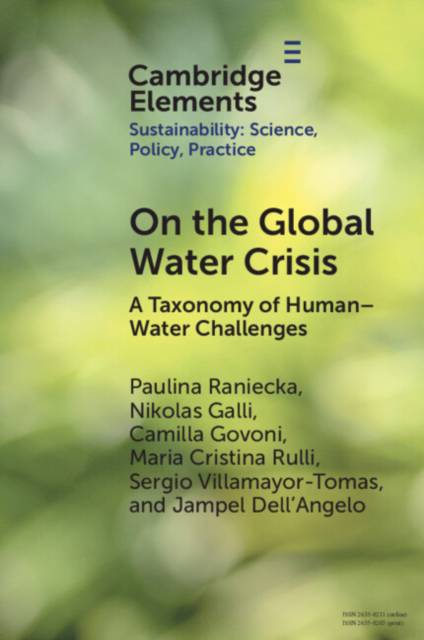
On the Global Water Crisis
A Taxonomy of Human–Water Challenges
Paulina Raniecka, Nikolas Galli, Camilla Govoni
€ 24,45
+ 48 punten
Omschrijving
The threat of an impending global water crisis has proliferated across water governance literature in the recent decades. However, defining the nature of this global water crisis remains a challenge, as a plethora of problems fall under this term. Simultaneously, contemporary waterscapes are hard to navigate due to the interconnected and wicked nature of water issues. Thus, to unravel this complex picture, it is fundamental to be reflexive about how water problems are identified, defined, and addressed. Conducting a systematic literature review and applying a constant comparison method, this Element identifies nine key human-water problématiques. Additionally, the analysis traces co-occurrences between diverse problématiques and their conceptual sub-clusters. Based on exhaustive literature, a reflection on the complex issue of 'what solutions?' is elaborated. Lastly, contributions to the ontological question of what a water problem is are offered, indicating a transition beyond an understanding of water issues as solely tangible.
Specificaties
Betrokkenen
- Auteur(s):
- Uitgeverij:
Inhoud
- Aantal bladzijden:
- 74
- Taal:
- Engels
- Reeks:
Eigenschappen
- Productcode (EAN):
- 9781009658867
- Verschijningsdatum:
- 2/04/2026
- Uitvoering:
- Paperback
- Formaat:
- Trade paperback (VS)
- Afmetingen:
- 152 mm x 229 mm
- Gewicht:
- 108 g


Alleen bij Standaard Boekhandel
+ 48 punten op je klantenkaart van Standaard Boekhandel
Cadeau

AANGERADEN


Beoordelingen
We publiceren alleen reviews die voldoen aan de voorwaarden voor reviews. Bekijk onze voorwaarden voor reviews.