


- Afhalen na 1 uur in een winkel met voorraad
- Gratis thuislevering in België vanaf € 30
- Ruim aanbod met 7 miljoen producten
- Afhalen na 1 uur in een winkel met voorraad
- Gratis thuislevering in België vanaf € 30
- Ruim aanbod met 7 miljoen producten





Omschrijving
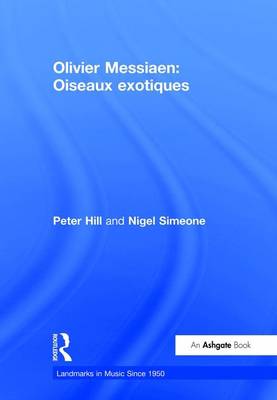
What makes Oiseaux exotiques so important is that it is arguably the first of Messiaen's major works to create a successful synthesis between his music and his passion for ornithology. The earliest composition to use birdsong to a significant extent was the Quatuor pour la fin du Temps (1940-41). A newspaper interview a few years later (France-Soir, 1948) demonstrates Messiaen's growing desire to move away from the stylization that had characterized the Quatuor towards a much greater realism, based on a close observation of birds in their natural habitat. At the same time, Messiaen continued to regard birdsong as music - and divinely inspired music at that - a belief that led for a time to an obsession with truth-to-nature. Against this background, Oiseaux exotiques proves to be a landmark, the work in which Messiaen the musician began to regain the upper hand over Messiaen the ornithologist. The introductory chapter (Chapter 1) outlines the background to Oiseaux exotiques, discussing Messiaen's relations with the 1950s avant garde - in particular with his former pupil Pierre Boulez - and his involvement with the concerts of the Domaine musical, for which Oiseaux exotiques was composed. In Chapter 2, access to Messiaen's sketches enables the authors to analyse his compositional methods in unprecedented detail; a generous number of music examples refer to birdsong recordings actually used by Messiaen (which can be heard on the accompanying CD), and trace step-by-step the evolution of musical ideas from first notation to finished score. Chapter 3 provides a commentary on the music, investigating issues of continuity and texture, and revealing the processes underlying the score's dazzling profusion. In two further chapters Peter Hill and Nigel Simeone recount the reception history of Oiseaux exotiques, and compare recorded interpretations, taking as their point of departure the historic premiere, included in full on the CD. Finally, the Conclusion considers
Specificaties
Betrokkenen
- Auteur(s):
- Uitgeverij:
Inhoud
- Aantal bladzijden:
- 140
- Taal:
- Engels
- Reeks:
Eigenschappen
- Productcode (EAN):
- 9780754656302
- Verschijningsdatum:
- 28/06/2007
- Uitvoering:
- Boek
- Formaat:
- Met stofomslag
- Afmetingen:
- 155 mm x 221 mm
- Gewicht:
- 358 g


Alleen bij Standaard Boekhandel
+ 364 punten op je klantenkaart van Standaard Boekhandel

Beoordelingen
We publiceren alleen reviews die voldoen aan de voorwaarden voor reviews. Bekijk onze voorwaarden voor reviews.