


- Afhalen na 1 uur in een winkel met voorraad
- Gratis thuislevering in België vanaf € 30
- Ruim aanbod met 7 miljoen producten
- Afhalen na 1 uur in een winkel met voorraad
- Gratis thuislevering in België vanaf € 30
- Ruim aanbod met 7 miljoen producten





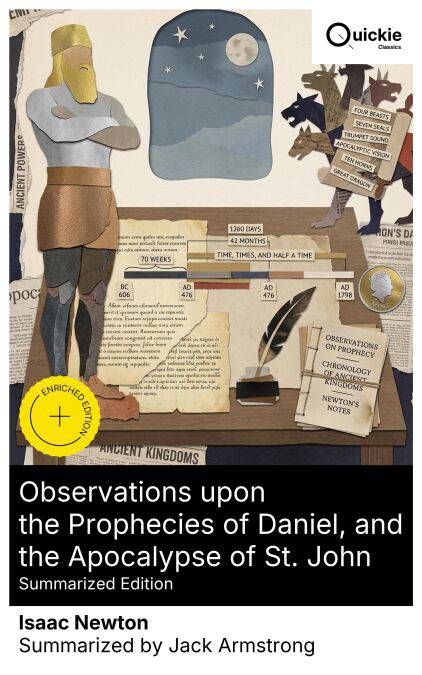
Observations upon the Prophecies of Daniel, and the Apocalypse of St. John (Summarized Edition) E-BOOK
Enriched edition. A Historicist Reading of Daniel and Revelation through Chronology and Church History
Isaac Newton
E-book | Engels
€ 1,99
+ 1 punten
Omschrijving
Posthumously published in 1733, Isaac Newton's Observations upon the Prophecies of Daniel, and the Apocalypse of St. John offers a rigorously historicist reading of biblical prophecy. In spare, methodical prose, Newton correlates Daniel's four kingdoms, the seventy weeks, and the 1,260 days with the long arc of imperial and ecclesiastical history, and aligns Revelation's seals, trumpets, and beasts accordingly. Drawing on philology, chronology, and the work of Joseph Mede, he assembles a dense apparatus of cross-references to Scripture, Fathers, and chroniclers, arguing for gradual fulfillment rather than sudden catastrophe. The author of the Principia was also a lifelong theologian. As Master of the Mint and President of the Royal Society, Newton cultivated an aversion to speculative enthusiasm; in private notebooks and drafts he pursued prophecy with the same evidential discipline he brought to natural philosophy. He consulted the original languages, patristic testimony, and conciliar history to recover primitive Christianity, and he resists confident date-setting, preferring large-scale periods and caution about timetable claims. This volume rewards historians of science, students of Reformation and Enlightenment exegesis, and curious lay readers; it is a bracing model of sober apocalyptic interpretation and an indispensable document of Newton's mind.
Quickie Classics summarizes timeless works with precision, preserving the author's voice and keeping the prose clear, fast, and readable—distilled, never diluted. Enriched Edition extras: Introduction · Synopsis · Historical Context · Author Biography · Brief Analysis · 4 Reflection Q&As · Editorial Footnotes.
Quickie Classics summarizes timeless works with precision, preserving the author's voice and keeping the prose clear, fast, and readable—distilled, never diluted. Enriched Edition extras: Introduction · Synopsis · Historical Context · Author Biography · Brief Analysis · 4 Reflection Q&As · Editorial Footnotes.
Specificaties
Betrokkenen
- Auteur(s):
- Uitgeverij:
Inhoud
- Aantal bladzijden:
- 100
- Taal:
- Engels
Eigenschappen
- Productcode (EAN):
- 8596547877929
- Verschijningsdatum:
- 9/01/2026
- Uitvoering:
- E-book
- Beveiligd met:
- Digital watermarking
- Formaat:
- ePub


Alleen bij Standaard Boekhandel
+ 1 punten op je klantenkaart van Standaard Boekhandel
Cadeau

AANGERADEN


Beoordelingen
We publiceren alleen reviews die voldoen aan de voorwaarden voor reviews. Bekijk onze voorwaarden voor reviews.