


- Afhalen na 1 uur in een winkel met voorraad
- Gratis thuislevering in België vanaf € 30
- Ruim aanbod met 7 miljoen producten
- Afhalen na 1 uur in een winkel met voorraad
- Gratis thuislevering in België vanaf € 30
- Ruim aanbod met 7 miljoen producten





€ 158,95
+ 317 punten
Omschrijving
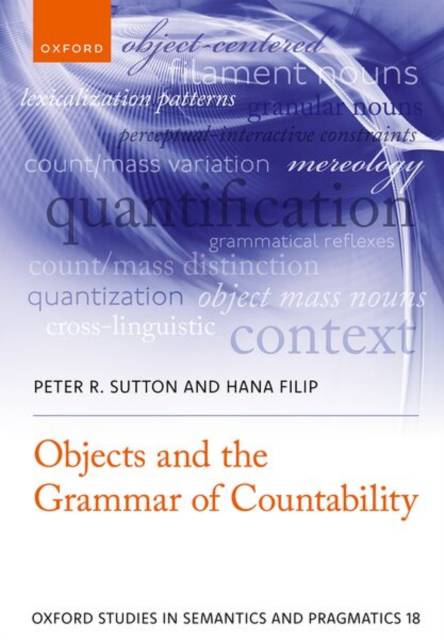
This book proposes an object-centred and contextualist account of the count/mass distinction. The main empirical finding is that there is a connection between variation in count/mass lexicalization patterns across and within languages and the ways in which mass or count nouns can diverge from manifesting the canonical grammatical reflexes expected of the count/mass distinction in a given language. Assuming compositional semantics enriched with Classical Extensional Mereology, Peter Sutton and Hana Filip propose that mass-count pairs of nouns (across and within languages) lexicalize the same number-neutral core property that is satisfied by objects, which comprises not only one discrete entity separate from other entities, but also a discrete entity based on its affordances and topological properties. For a concrete common noun to be grammatically count, as needed in counting and quantificational constructions, it must specify a quantized set of objects relative to a context of individuation. Context plays a crucial role, since it can afford different ways of viewing the entities in a noun's extension, and so what counts as 'one' for that noun in that context. The book outlines a system of three perceptual-interactive constraints, based upon how we perceive and interact with objects, that predicts the propensity for a number-neutral core property that is satisfied by objects to nonetheless be lexicalized as mass. These constraints are also key to explaining variation in the count/mass lexicalization patterns of such properties. The authors also show that the extent to which a core property can satisfy these constraints can be estimated from a corpus, and how these corpus measures can be used to model variation in count/mass lexicalization patterns. The main data relies on concrete common nouns in number-marking languages, namely Czech, English, Finnish, and German, but the account is also extended to abstract nouns, and to two non-number-marking languages, namely Mandarin and Yudja.
Specificaties
Betrokkenen
- Auteur(s):
- Uitgeverij:
Inhoud
- Aantal bladzijden:
- 288
- Taal:
- Engels
- Reeks:
Eigenschappen
- Productcode (EAN):
- 9780192891143
- Verschijningsdatum:
- 27/11/2026
- Uitvoering:
- Hardcover
- Formaat:
- Genaaid
- Afmetingen:
- 171 mm x 246 mm


Alleen bij Standaard Boekhandel
+ 317 punten op je klantenkaart van Standaard Boekhandel
Cadeau

AANGERADEN


Beoordelingen
We publiceren alleen reviews die voldoen aan de voorwaarden voor reviews. Bekijk onze voorwaarden voor reviews.