



- Afhalen na 1 uur in een winkel met voorraad
- In januari gratis thuislevering in België
- Ruim aanbod met 7 miljoen producten
- Afhalen na 1 uur in een winkel met voorraad
- In januari gratis thuislevering in België
- Ruim aanbod met 7 miljoen producten





€ 2,99
+ 2 punten
Omschrijving
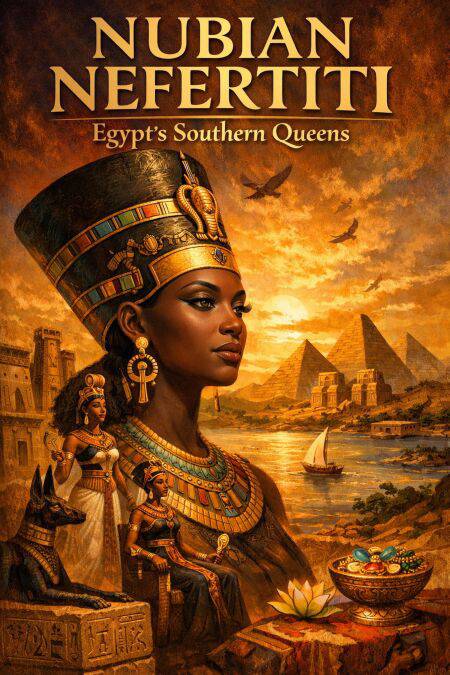
For too long, the story of ancient feminine power along the Nile has been told through a single face — the serene, iconic profile of Egypt's Nefertiti, whose limestone bust has become the universal symbol of ancient queenship. Yet south of Egypt's borders, beyond the churning cataracts of the upper Nile, an equally magnificent tradition of female sovereignty flourished for more than two thousand years, producing queens of extraordinary courage, intelligence, and constitutional authority whose stories have remained, until now, largely beyond the reach of popular historical imagination. Nubian Nefertiti: Egypt's Southern Queens is the sweeping, richly detailed account of these remarkable women — the Kandakes of Kush, the God's Wives of Thebes, the warrior queens of Meroe — whose legacy in stone and gold represents one of the ancient world's most remarkable experiments in feminine sovereignty.
Drawing on the latest archaeological discoveries, inscriptional evidence, and cross-disciplinary scholarship, this book traces the full arc of Nubian queenly tradition from its deep roots in the prehistoric Kerma civilization — one of Africa's earliest urban cultures — through the imperial grandeur of the Meroitic Kingdom and into the medieval Christian courts of the post-Meroitic Nile Valley. At the heart of the narrative stands the institution of the Kandake: the constitutionally embedded tradition of female authority that made the queens of Kush not merely the consorts of powerful men but sovereign rulers in their own right, commanding armies, managing continental trade networks, negotiating treaties with Roman emperors, and serving as the earthly embodiments of divine power in one of antiquity's most sophisticated religious traditions.
Among the extraordinary women whose lives and reigns are explored in vivid detail are Amanirenas — the one-eyed warrior queen who led her armies against the legions of Augustus Caesar and forced the Roman Empire to negotiate on equal terms; Amanishakheto — the builder queen whose looted golden treasury, now divided between museums in Munich and Berlin, represents the pinnacle of ancient African goldsmithing; Amanitore — the most monumentally represented queen in Meroitic history, whose temple construction program stretched from the Sudanese heartland to the sacred island of Philae; and Amenirdis I — the Nubian princess whose installation as God's Wife of Amun transformed the holiest office in Egyptian religious life into an instrument of Kushite imperial governance.
Beyond the individual biographies of these remarkable women, the book examines the structural foundations that made their authority possible — the matrilineal succession laws, the religious institutions, the economic systems, and the artistic traditions through which the civilization of Kush expressed and perpetuated its distinctive vision of female sovereignty. It confronts honestly the colonial scholarship that marginalized Nubian history for generations, celebrates the African and Sudanese scholars who are reclaiming it, and considers the urgent contemporary questions of cultural repatriation and historical justice that the story of the Nubian queens inevitably raises.
Accessible to the general reader yet grounded in the most current scholarship, Nubian Nefertiti: Egypt's Southern Queens is an act of historical recovery long overdue — a passionate, meticulously researched tribute to the women who built pyramids, defied empires, and left, in the permanent language of stone and gold, a testimony to the reality and the dignity of African feminine power that three thousand years of forgetting have not been able to silence.
Specificaties
Betrokkenen
- Auteur(s):
- Uitgeverij:
Inhoud
- Taal:
- Engels
Eigenschappen
- Productcode (EAN):
- 9798233272981
- Verschijningsdatum:
- 10/04/2026
- Uitvoering:
- E-book
- Formaat:
- ePub


Alleen bij Standaard Boekhandel
+ 2 punten op je klantenkaart van Standaard Boekhandel
Cadeau

AANGERADEN


Beoordelingen
We publiceren alleen reviews die voldoen aan de voorwaarden voor reviews. Bekijk onze voorwaarden voor reviews.