


- Afhalen na 1 uur in een winkel met voorraad
- Gratis thuislevering in België vanaf € 30
- Ruim aanbod met 7 miljoen producten
- Afhalen na 1 uur in een winkel met voorraad
- Gratis thuislevering in België vanaf € 30
- Ruim aanbod met 7 miljoen producten





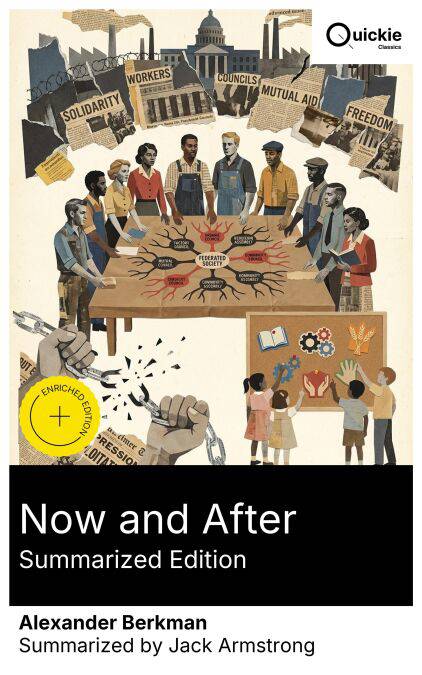
Now and After (Summarized Edition) E-BOOK
Enriched edition. Mutual aid, workers' self-management, federated councils, and lessons of 1917—a lucid primer in anarchist communism against authoritarianism
Alexander Berkman
E-book | Engels
€ 0,49
Omschrijving
Now and After, subtitled The ABC of Anarchism, distills the aims and mechanics of anarchist communism. Berkman surveys the roots of exploitation and authority, critiques wage labor, private property, prisons, and the state, and sketches how free communism might organize production, education, and justice through federated councils and voluntary association. He answers common objections about human nature and disorder, grounding ethics in mutual aid. Written in lucid, didactic prose with examples and Socratic questions, the book stands in the Kropotkin–Malatesta line yet addresses the crises opened by 1917. Berkman, a Russian‑born American anarchist and close comrade of Emma Goldman, wrote from hard‑won experience. His 1892 attentat against Henry Clay Frick led to fourteen years in prison; deported in 1919 during the Palmer Raids, he observed Bolshevik rule firsthand and broke with authoritarian socialism. Those ordeals, together with decades of labor agitation and immigrant education, impelled him to craft a clear, anti‑dogmatic primer for workers and students bewildered by revolution's promises, failures, and the practical questions of building freedom. Essential for readers seeking humane alternatives to capitalist inequality and party despotism. For students, organizers, and the curious, it offers accessible argument, historical sobriety, and durable provocation.
Quickie Classics summarizes timeless works with precision, preserving the author's voice and keeping the prose clear, fast, and readable—distilled, never diluted. Enriched Edition extras: Introduction · Synopsis · Historical Context · Brief Analysis · 4 Reflection Q&As · Editorial Footnotes.
Quickie Classics summarizes timeless works with precision, preserving the author's voice and keeping the prose clear, fast, and readable—distilled, never diluted. Enriched Edition extras: Introduction · Synopsis · Historical Context · Brief Analysis · 4 Reflection Q&As · Editorial Footnotes.
Specificaties
Betrokkenen
- Auteur(s):
- Uitgeverij:
Inhoud
- Aantal bladzijden:
- 134
- Taal:
- Engels
Eigenschappen
- Productcode (EAN):
- 8596547877912
- Verschijningsdatum:
- 09/01/2026
- Uitvoering:
- E-book
- Beveiligd met:
- Digital watermarking
- Formaat:
- ePub


Alleen bij Standaard Boekhandel
Cadeau

AANGERADEN


Beoordelingen
We publiceren alleen reviews die voldoen aan de voorwaarden voor reviews. Bekijk onze voorwaarden voor reviews.