


- Afhalen na 1 uur in een winkel met voorraad
- Gratis thuislevering in België vanaf € 30
- Ruim aanbod met 7 miljoen producten
- Afhalen na 1 uur in een winkel met voorraad
- Gratis thuislevering in België vanaf € 30
- Ruim aanbod met 7 miljoen producten





Omschrijving
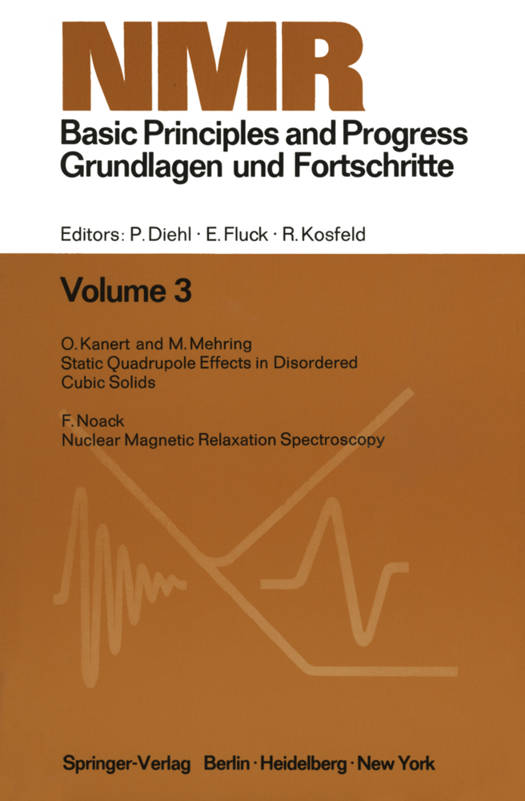
Nuclear magnetic resonance spectroscopy, which has evolved only within the last 20 years, has become one of the very important tools in chemistry and physics. The literature on its theory and application has grown immensely and a comprehensive and adequate treatment of all branches by one author, or even by several, becomes increasingly difficult. This series is planned to present articles written by experts working in various fields of nuclear magnetic resonance spectroscopy, and will contain review articles as well as progress reports and original work. Its main aim, however, is to fill a gap, existing in literature, by publishing articles written by specialists, which take the reader from the introductory stage to the latest development in the field. The editors are grateful to the authors for the time and effort spent in writing the articles, and for their invaluable cooperation. The Editors Contents o. Kanert and M. Mehring Static Quadrupole Effects in Disordered Cubic Solids 1 F. Noack Nuclear Magnetic Relaxation Spectroscopy 83 Static Quadrupole Effects in Disordered Cubic Solids O. KANERT and M. MEHRING Physikalisches Institut der Universitat MUnster, BRD Contents I. Introduction. . . . . . . . . . . . . . . . . . . . . . . . . . . . . . . . . . . . . . . . . . . . . . . . 3 II. Fundamentals . . . . . . . . . . . . . . . . . . . . . . . . . . . . . . . . . . . . . . . . . . . . . . 4 1. Zero Field Spectra . . . . . . . . . . . . . . . . . . . . . . . . . . . . . . . . . . . . . . . . 4 2. High Field Spectra . . . . . . . . . . . . . . . . . . . . . . . . . . . . . . . . . . . . . . . . 6 3. Transformation of the Electric Field Gradient Tensor . . . . . . . . . . 7 III. The Influence of the Quadrupole Perturbation on the NMR Signal . 8 1. General Theory . . . . .. . . . . . . . . . . . . . . . . . . . . . . . . . . . . . . . . . . . . . 8 a) The Free Induction Decay . . . . . . . . . . . . . . . . . . . . . . . . . . . . . . . 8 b) The Wide-Line Signal . . . . . . . . . . . . . . . . . . . . . . . . . . . . . . . . . . . 11 c) The Spin Echo Signal . . . . . . . . . . . . . . . . . . . . . . . . . . . . . . . .: . .
Specificaties
Betrokkenen
- Auteur(s):
- Uitgeverij:
Inhoud
- Aantal bladzijden:
- 144
- Taal:
- Engels
- Reeks:
- Reeksnummer:
- nr. 3
Eigenschappen
- Productcode (EAN):
- 9783642651823
- Verschijningsdatum:
- 19/11/2011
- Uitvoering:
- Paperback
- Formaat:
- Trade paperback (VS)
- Afmetingen:
- 170 mm x 244 mm
- Gewicht:
- 258 g


Alleen bij Standaard Boekhandel
+ 336 punten op je klantenkaart van Standaard Boekhandel
Wedstrijd


Beoordelingen
We publiceren alleen reviews die voldoen aan de voorwaarden voor reviews. Bekijk onze voorwaarden voor reviews.