


- Afhalen na 1 uur in een winkel met voorraad
- Gratis thuislevering in België vanaf € 30
- Ruim aanbod met 7 miljoen producten
- Afhalen na 1 uur in een winkel met voorraad
- Gratis thuislevering in België vanaf € 30
- Ruim aanbod met 7 miljoen producten





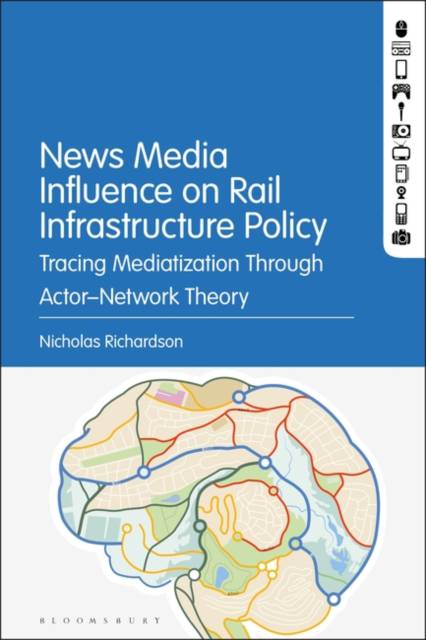
News Media Influence on Rail Infrastructure Policy
Tracing Mediatization Through Actor-Network Theory
Nicholas Richardson
Hardcover | Engels
€ 220,45
+ 440 punten
Omschrijving
In this book, Richardson's research spans a decade and two cities - Sydney, Australia and Montreal, Canada - focusing on three metro-style rail infrastructure case study projects: one ongoing, one failed and one upgraded after reaching fifty years of age - to build an irrefutable case that the news media is highly influential to policy, and that these influences are complex, messy and changing.
News Media Influence on Rail Infrastructure Policy offers scholars and industry practitioners in the arenas of policy analysis, politics and media communications a method for astutely guiding large-scale projects through the complex and changing landscape of 24/7 news media. It is underpinned by empirical research that identifies and endeavors to close a considerable gap in current understanding and practice. This gap represents a failure to recognise and respect mediatization - the many powerful influences impacting a policy arena that has drawn the ire of the news media. The result of this failure is ineffective communication that does little to advance the policy piece and, in the worst instances, leads to policy immobilisation or poor policy decision-making. Drawing significantly on Actor--Network Theory, Richardson identifies the influential actors and alliances at play when policy is subjected to media discourse, and he proposes a framework for tracing and managing them. In doing so, he demonstrates that such a framework is not only vital for the successful negotiation of policy and projects in the media, but also to an (r)evolutionary recasting of public, expert and media actors in the development and decision-making process.Specificaties
Betrokkenen
- Auteur(s):
- Uitgeverij:
Inhoud
- Aantal bladzijden:
- 304
- Taal:
- Engels
Eigenschappen
- Productcode (EAN):
- 9781501387487
- Verschijningsdatum:
- 16/11/2023
- Uitvoering:
- Hardcover
- Formaat:
- Genaaid
- Afmetingen:
- 152 mm x 229 mm
- Gewicht:
- 571 g


Alleen bij Standaard Boekhandel
+ 440 punten op je klantenkaart van Standaard Boekhandel
Cadeau

AANGERADEN


Beoordelingen
We publiceren alleen reviews die voldoen aan de voorwaarden voor reviews. Bekijk onze voorwaarden voor reviews.