


- Afhalen na 1 uur in een winkel met voorraad
- Gratis thuislevering in België vanaf € 30
- Ruim aanbod met 7 miljoen producten
- Afhalen na 1 uur in een winkel met voorraad
- Gratis thuislevering in België vanaf € 30
- Ruim aanbod met 7 miljoen producten





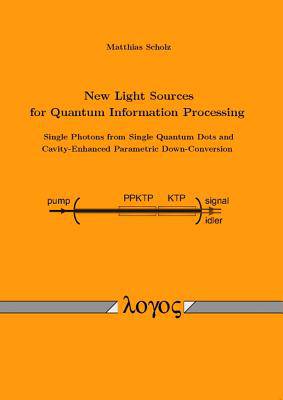
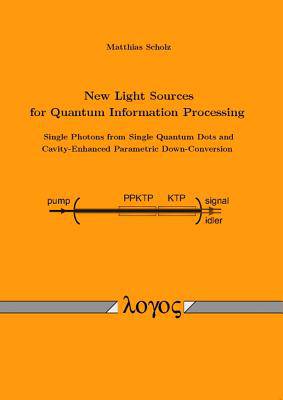
New Light Sources for Quantum Information Processing -- Single Photons from Single Quantum Dots and Cavity-Enhanced Parametric Down-Conversion
Matthias Scholz
Paperback | Engels
€ 88,95
+ 177 punten
Omschrijving
The outstanding research efforts in quantum information processing over the past two decades reflect the promise this field of physics provides for practical applications in information science as well as for new approaches towards a better understanding of fundamental questions in quantum mechanics. This thesis focuses on the photon as a principal resource to perform quantum information tasks and on schemes to imprint quantum bits onto its various degrees of freedom. Its weak coupling to the environment makes the photon an ideal carrier to securely transmit information by quantum cryptographic protocols. Moreover, efficient implementations of quantum computing using solely linear optics have been proven. Unfortunately, scalability is not easily achieved by a purely photonic approach since the generation of indistinguishable single photons from multiple emitters remains a difficult task. Thus, proposals for more complex quantum networks suggest an architecture with single photons as information carriers between atomic ensembles that act as storage and processing nodes. Computations including a limited number of qubits, however, may be performed by the linear optics scheme. The thesis starts with the generation and characterization of single-photon states, using a source based on a single optically pumped quantum dot. The capability of these states to implement a quantum algorithm using linear optics and single-photon interference is experimentally demonstrated for the first time. Error correction makes the interferometric setup robust against phase-noise. After successful realization of this proof-of-principle experiment, attention is drawn to the need of plug-and-play single-photon sources. Especially quantum key distribution, the most advanced quantum information technology to date which has even found its way into commercial devices, requires compact and low-cost non-classical light sources.Therefore, a single-photon source based on electrically pumped quantum dots is presented that exhibits unmatched spectral purity and single-photon statistics. Results towards the realization of quantum networks are presented in the following chapters, covering the generation of narrow-band single photons which can efficiently couple to atomic resonances. Photons with a spectral width of less than 3 MHz are created by ultra-bright cavity-enhanced spontaneous parametric down-conversion, and their quantum statistics is studied in detail. A setup for time-bin encoding is demonstrated, capable of imprinting quantum information onto these narrow-band single photons. This thesis concludes with slow-light experiments in atomic ensembles as a model system for atom-photon interaction on the single-photon level. The described experiments demonstrate striking features that make the single photon one of the most remarkable physical systems for the field of quantum information.
Specificaties
Betrokkenen
- Auteur(s):
- Uitgeverij:
Inhoud
- Aantal bladzijden:
- 180
- Taal:
- Engels
Eigenschappen
- Productcode (EAN):
- 9783832522209
- Verschijningsdatum:
- 12/06/2009
- Uitvoering:
- Paperback
- Formaat:
- Trade paperback (VS)
- Afmetingen:
- 145 mm x 211 mm
- Gewicht:
- 254 g


Alleen bij Standaard Boekhandel
+ 177 punten op je klantenkaart van Standaard Boekhandel
Wedstrijd


Beoordelingen
We publiceren alleen reviews die voldoen aan de voorwaarden voor reviews. Bekijk onze voorwaarden voor reviews.