



- Afhalen na 1 uur in een winkel met voorraad
- In januari gratis thuislevering in België
- Ruim aanbod met 7 miljoen producten
- Afhalen na 1 uur in een winkel met voorraad
- In januari gratis thuislevering in België
- Ruim aanbod met 7 miljoen producten





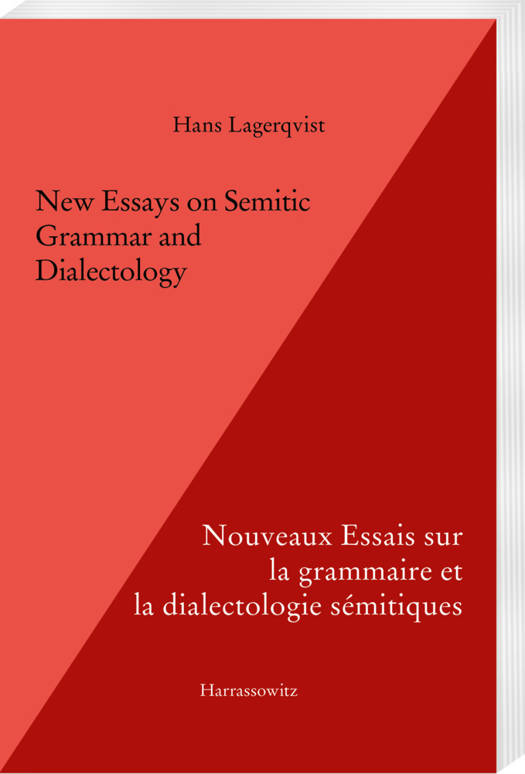
New Essays on Semitic Grammar and Dialectology. Nouveaux Essais sur la grammaire et la dialectologie sémitiques
Hans Lagerqvist
Paperback | Engels
€ 37,45
+ 74 punten
Omschrijving
Hans Lagerqvist presents four new essays that form the continuation of his collection Four Essays on Semitic Grammar and Dialectology / Quatre Essais sur la grammaire et la dialectologie sé-mitiques from 2020. The first essay, entitled 'The i / u rhyme in pre-Islamic poetry and the Qur an studied from a phonetic and phonologic perspective' analyzes this somewhat odd rhyme as it appears in pre-Islamic poetry and in the Qur an. The author proposes an objective approach based on phonetic and phonologic analysis. The second essay, 'Le syntagme élatif en arabe classique et standard moderne: Origine et morphosyntaxe', represents an attempt to go beyond the traditional descriptions of the Arabic elative by giving the analysis a more theoretical and linguistic character. The third essay, 'Syncrétisme paradigmatique aux 1re et 4e personnes: nekteb - neketbu (Maghreb), nx eb - nx bi (Malula)', studies the 1st and 4th persons of the imperfect tense, which are characterized by syncretism, as both begin with an initial n. Finally, the fourth essay, 'The future particles sawfa and sa- in the Qur an, the Acts of the Apostles (Mt. Sinai Arabic Codex 151:2) and pre-Islamic poetry' explores the origin of the Arabic future particles sawfa and sa-, which have been enigmatic for a long time.
Specificaties
Betrokkenen
- Auteur(s):
- Uitgeverij:
Inhoud
- Taal:
- Engels
Eigenschappen
- Productcode (EAN):
- 9783447124669
- Uitvoering:
- Paperback
- Afmetingen:
- 144 mm x 12 mm
- Gewicht:
- 281 g


Alleen bij Standaard Boekhandel
+ 74 punten op je klantenkaart van Standaard Boekhandel
Cadeau

AANGERADEN


Beoordelingen
We publiceren alleen reviews die voldoen aan de voorwaarden voor reviews. Bekijk onze voorwaarden voor reviews.