


- Afhalen na 1 uur in een winkel met voorraad
- Gratis thuislevering in België vanaf € 30
- Ruim aanbod met 7 miljoen producten
- Afhalen na 1 uur in een winkel met voorraad
- Gratis thuislevering in België vanaf € 30
- Ruim aanbod met 7 miljoen producten





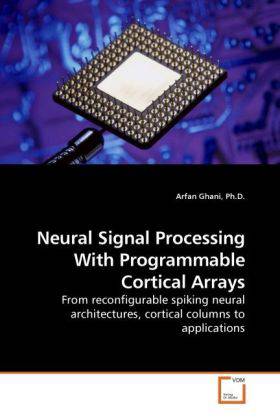
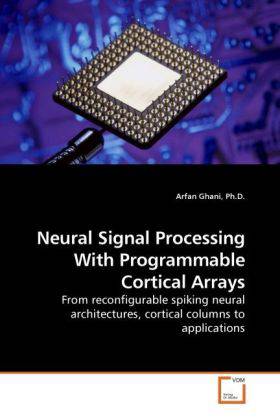
Neural Signal Processing With Programmable Cortical Arrays
From reconfigurable spiking neural architectures, cortical columns to applications
Arfan Ghani
Paperback | Engels
€ 77,95
+ 155 punten
Omschrijving
Recent years have witnessed some neuro-inspired engineering developments, to name a few (Neuromorphic chip design, adaptable and autonomous sensor networks, neuroprosthesis and neuro-electronics based on nanotechnology) but the huge challenge remains where rapid developments involving the interplay of biology, computer sciences, mathematics and engineering have yet to be seen. The book first explores different biologically realistic mathematical models of cortical spiking neurons and time-efficient ways for their mapping on reconfigurable hardware. This book then turns to the complexity of neural representation with a thorough literature review and state-of-the-art in neural hardware/software co-design. Next, it examines one of the few existing theoretical frameworks for modelling cortical circuits/columns and proposes solutions for their implementation on reconfigurable hardware, termed as Field Programmable Cortical Arrays. Finally, the book looks at design partitioning on hardware/software platforms, including the use of cortical columns in the context of speech recognition application. This book is written for researchers and professionals both in academia and industry.
Specificaties
Betrokkenen
- Auteur(s):
- Uitgeverij:
Inhoud
- Aantal bladzijden:
- 212
- Taal:
- Engels
Eigenschappen
- Productcode (EAN):
- 9783639216301
- Verschijningsdatum:
- 21/12/2009
- Uitvoering:
- Paperback
- Formaat:
- Trade paperback (VS)
- Afmetingen:
- 152 mm x 229 mm
- Gewicht:
- 317 g


Alleen bij Standaard Boekhandel
+ 155 punten op je klantenkaart van Standaard Boekhandel
Cadeau

AANGERADEN


Beoordelingen
We publiceren alleen reviews die voldoen aan de voorwaarden voor reviews. Bekijk onze voorwaarden voor reviews.