


- Afhalen na 1 uur in een winkel met voorraad
- Gratis thuislevering in België vanaf € 30
- Ruim aanbod met 7 miljoen producten
- Afhalen na 1 uur in een winkel met voorraad
- Gratis thuislevering in België vanaf € 30
- Ruim aanbod met 7 miljoen producten





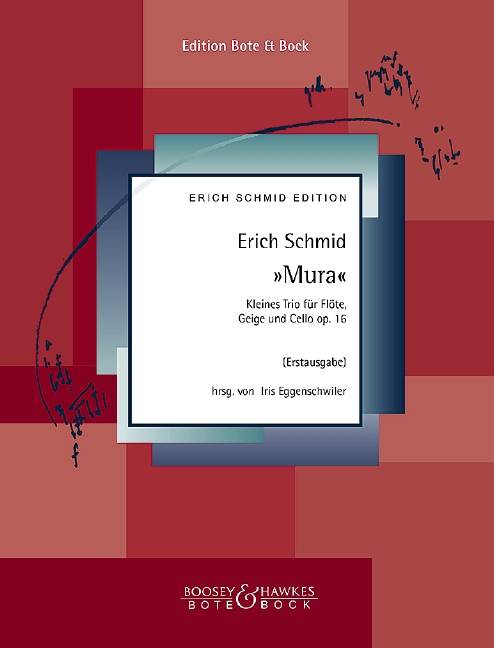
Mura
Kleines Trio für Flöte, Geige und Cello. Vol. XIII. op. 16. flute, violin and cello. Partition et parties.
€ 84,00
+ 168 punten
Omschrijving
As an orchestra conductor, choir director and university lecturer, Erich Schmid (1907-2000) did a great deal for having world premieres and radio broadcasts of contemporary music in Switzerland. He studied with Bernhard Sekles, among others, then with Arnold Schoenberg, and followed the aesthetics of the New Viennese School in his compositions. The historical-critical Erich Schmid Edition publishes, for the first time, all sixteen works with opus numbers as well as three additional piano works.
Mura, the 'little trio for flute, violin and cello' from 1955, is the last of his works; the direction of the Zurich Tonhalle Orchestra, which Schmid had taken over in 1949, was, to him, in conflict with his compositional work. Mura is tailored to the level of his children's playing and technique, who were then aged 18, 15 and 12 respectively and to whom he dedicated the piece. Although primarily a composition for private use, Schmid 'authorised' it with an opus number. Relatively easy to play, the five short movements allow musicians who did not study music to encounter free tonality or, in the case of the scherzo, framed by two slow and two fast movements and forming the centre of the divertimento-like large-scale form, dodecaphony.
Instrumentation:
flute, violin and cello
op. 16
Mura, the 'little trio for flute, violin and cello' from 1955, is the last of his works; the direction of the Zurich Tonhalle Orchestra, which Schmid had taken over in 1949, was, to him, in conflict with his compositional work. Mura is tailored to the level of his children's playing and technique, who were then aged 18, 15 and 12 respectively and to whom he dedicated the piece. Although primarily a composition for private use, Schmid 'authorised' it with an opus number. Relatively easy to play, the five short movements allow musicians who did not study music to encounter free tonality or, in the case of the scherzo, framed by two slow and two fast movements and forming the centre of the divertimento-like large-scale form, dodecaphony.
Instrumentation:
flute, violin and cello
op. 16
Specificaties
Betrokkenen
- Uitgeverij:
Inhoud
- Aantal bladzijden:
- 88
- Reeks:
Eigenschappen
- Productcode (EAN):
- 9783793142522
- Verschijningsdatum:
- 01/03/2021
- Afmetingen:
- 231 mm x 303 mm
- Gewicht:
- 1 g

Alleen bij Standaard Boekhandel
+ 168 punten op je klantenkaart van Standaard Boekhandel
Cadeau

AANGERADEN


Beoordelingen
We publiceren alleen reviews die voldoen aan de voorwaarden voor reviews. Bekijk onze voorwaarden voor reviews.